The Many Lives of a Gourd: The Tumba Craft of Odisha
Updated On: 24 November, 2026 04:12 PM IST | Mumbai | Buzz
Discover how Odisha’s tumba craft transforms bottle gourds into handmade art while supporting tribal livelihoods.



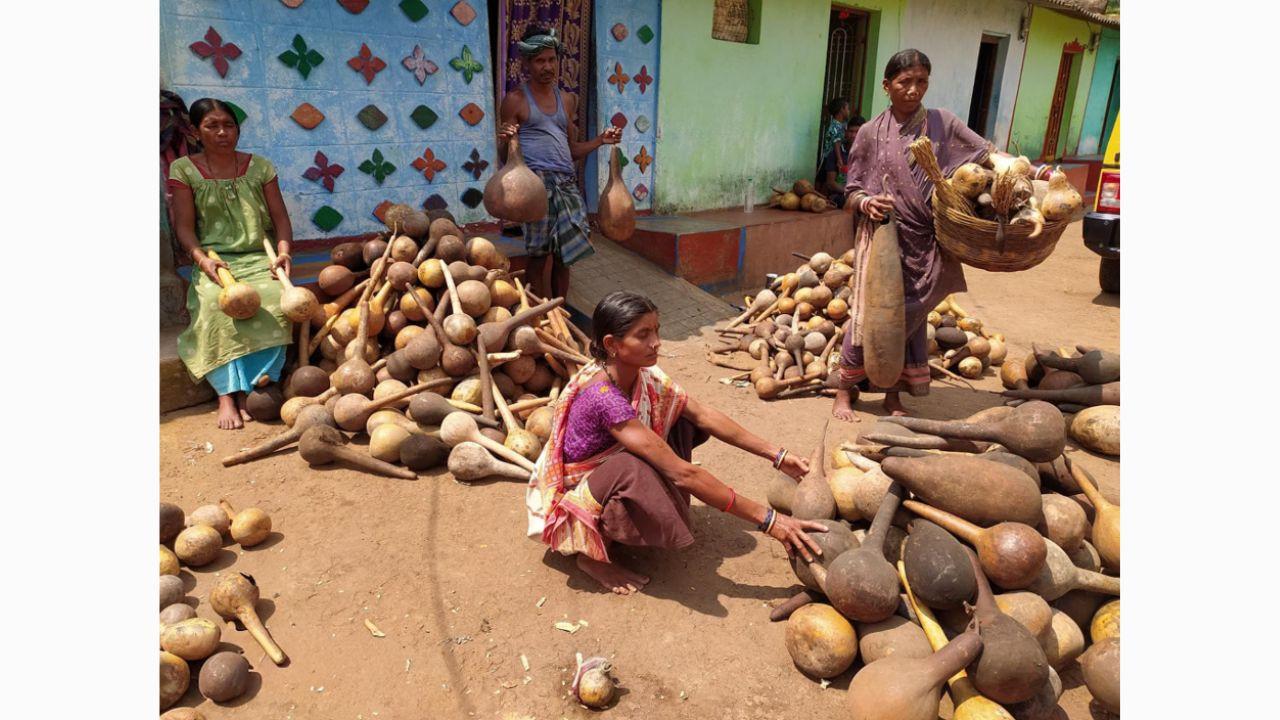
By Indrani Chakraborty & Soumya Mukherji.
In Odisha’s tribal communities, the humble bottle gourd has long served as a water and seed storage vessel, a container for traditional beverages, and a musical instrument. Today, artisans are giving this versatile material a new life as handcrafted art, creating livelihoods while keeping traditional knowledge alive.
The bottle gourd, called ‘tumba’ in Odia, is one of humanity’s oldest cultivated plants. Studies suggest that it was domesticated in Africa around 12,500 years ago (c. 10,500 BCE) and later spread across the world. Erickson et al. (2005) found evidence of bottle gourds in East Asia by 9,000–8,000 BP and in the Americas by about 10,000 BP, describing them as “among the earliest domesticates.” Kistler et al. (2014) proposed that wild African gourds drifted across the Atlantic during the Late Pleistocene and were later domesticated in the Americas. Zhao et al. (2024) also support an African origin around 12,500 BP, suggesting that gourds reached the Americas through Atlantic drift and spread into Eurasia during the Early Holocene. Notably, the bottle gourd was among the very few crops with a trans-Pacific distribution before Columbus.
Other Articles
ADVERTISEMENT
Mid-Day Fast
ADVERTISEMENT