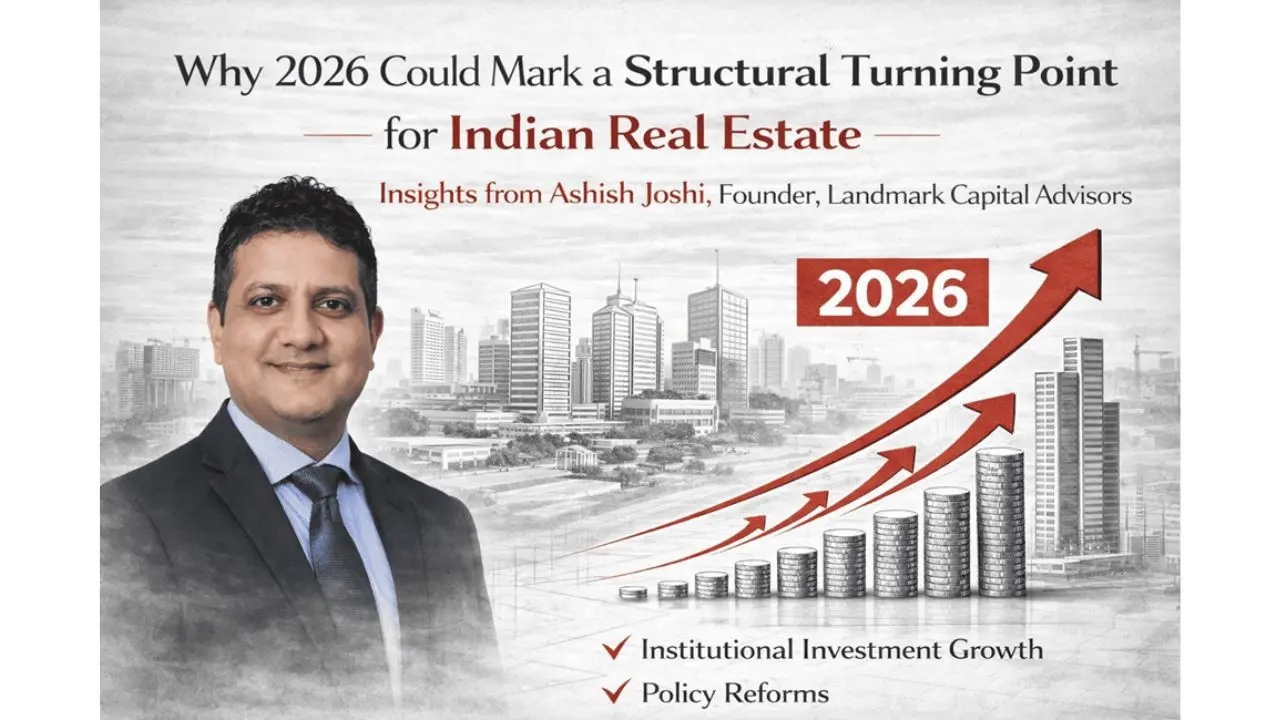
Ashish Joshi on why 2026 could mark a disciplined, governance-led shift in Indian real estate.

Mr. Ashish Joshi, Managing Director, Landmark Capital Advisors
As India consolidates its position among the world’s fastest-growing major economies, its real estate sector is entering a structurally different phase-one defined not merely by expansion, but by institutional depth, capital discipline, and governance transparency.
According to Ashish Joshi, Founder of Landmark Capital Advisors, 2026 may represent a decisive shift in how investors assess risk, return, and operational execution within Indian real estate.
With extensive experience in capital structuring and institutional advisory, Joshi has closely observed the evolution of India’s property cycle-from leverage-led expansion to income-focused investing.
Through Landmark Capital Advisors, he has consistently advocated structured capital deployment, governance-led underwriting, and downside protection frameworks.
India’s Macro Momentum: From Growth to Quality of Growth
India is projected to grow at approximately 6.5%–7% annually, making it the fastest-growing major economy globally (IMF, FY25–26 estimates). Strong domestic consumption, infrastructure expansion, manufacturing incentives (PLI schemes), and services exports continue to underpin macro stability.
India’s real estate sector is expected to reach USD 1 trillion in market size by 2030, contributing nearly 13% to GDP, up from ~7% currently (IBEF estimates).
However, as Ashish Joshi notes:
“The real shift heading into 2026 is not growth itself-it is the quality of capital and quality of underwriting.”
Earlier cycles were momentum-driven. Today’s capital is increasingly patient, income-focused, and governance-conscious. Landmark Capital Advisors views this as a sign of institutional maturation rather than cyclical exuberance.
Why 2026 May Be a Defining Year
Over the past two years, investor conversations were dominated by capital appreciation. But multiple research reports now indicate stabilization in prime asset yields:
- Office cap rates in top-tier assets have largely stabilized (JLL & CBRE reports, 2024–25).
- Institutional inflows into Indian real estate reached record levels of USD 8-11 billion annually in 2024-25, with office, residential, and industrial assets accounting for ~60% of allocations (JLL, CBRE, Colliers)
As yield compression moderates, future performance will increasingly depend on:
- Rental growth sustainability
- Tenant credit strength
- Lease tenure visibility
- Operational efficiency
Landmark Capital Advisors’ internal assessments suggest that return dispersion will widen in 2026. Broad exposure to “India growth” will not suffice; asset-level precision will determine outcomes.
Institutional Capital: From Aggression to Selectivity
Institutional capital participation in Indian real estate has grown materially over the past decade.
Global pension funds, sovereign wealth funds, and PE platforms now account for a substantial share of large-ticket transactions.
However, capital is becoming more selective:
- Structured governance frameworks
- Strong sponsor track records
- Transparent reporting standards
- Downside-protected capital stacks Ashish Joshi emphasizes that:
“Capital preservation and structural integrity are becoming as important as headline IRR.”
At Landmark Capital Advisors, underwriting frameworks prioritize scenario analysis, refinancing discipline, and cash-flow resilience over speculative upside.
Office Real Estate: Resilient but Differentiated
India recorded record gross office leasing exceeding 60 million sq. ft. in 2023 and scaled new highs of 70-83 million sq. ft. annually in 2024-25 (CBRE & JLL data). Global Capability Centres (GCCs) alone account for nearly 35– 40% of Grade-A office demand.
India currently hosts over 1,600+ GCCs, employing more than 1.6 million professionals, and this number is projected to grow significantly through 2030.
However, performance divergence is emerging:
- Grade-A, transit-connected assets are witnessing strong occupancy and rental resilience.
- Secondary stock faces rising vacancy risk.
Ashish Joshi believes 2026 will amplify this differentiation:
“Asset quality and tenant stability will matter more than sector-level exposure.”
Landmark Capital Advisors anticipates widening return dispersion across micro-markets and asset grades.
Residential: From Price Momentum to Normalization
Residential markets across Mumbai, NCR, Bengaluru, and Hyderabad have seen significant price appreciation over the past 24 months. According to ANAROCK and Knight Frank:
- Housing sales across top 7 cities exceeded 4 lakh units in 2023, a decade high.
- Premium and luxury segments saw the strongest growth.
- Unsold inventory levels declined materially compared to pre-2020 levels.
However, as price momentum stabilizes, future growth is likely to align more closely with:
- End-user income growth
- Mortgage affordability
- Construction execution timelines
Ashish Joshi highlights that in this phase, execution discipline and balance sheet strength will define project-level success.
Landmark Capital Advisors increasingly guides investors to assess governance standards, funding structures, and sponsor credibility alongside location advantages.
Evolving Investor Expectations
Investor evaluation frameworks are becoming more sophisticated.
Earlier cycles prioritized headline IRR. Today, investors are scrutinizing:
- Capital velocity
- Cash-flow visibility
- Leverage ratios
- Refinance risk
- Exit optionality
This shift toward structural metrics signals long-term confidence in India’s property markets.
Landmark Capital Advisors integrates downside modeling, stress-testing, and phased deployment strategies into its advisory processes-reflecting a transition from opportunistic investing to institutional rigor.
Operational Alpha: The New Differentiator
Industry experts increasingly agree that operational execution will define the next cycle. Key drivers include:
- Active leasing strategies
- Tenant retention programs
- Structured refinancing
- Asset repositioning
- ESG compliance and reporting Ashish Joshi notes:
“Execution now replaces expansion as the primary differentiator.”
At Landmark Capital Advisors, structured oversight and phased capital deployment remain foundational to mitigating volatility.
Governance as the Core Capital Magnet
Institutional capital demands:
- Transparent reporting
- Alignment of interest
- Regulatory compliance
- Structured documentation
Platforms lacking governance clarity will struggle to attract durable long-term capital. Ashish Joshi asserts:
“Governance is not an overlay-it is the infrastructure of trust.”
Landmark Capital Advisors embeds compliance integrity and reporting transparency into its advisory approach, aligning with global investor expectations.
The Five-Year Outlook: Institutional Maturity
Over the next five years, Indian real estate is likely to become:
- More income-oriented
- Less speculative
- Structurally institutional
- Governance-aligned
India’s demographic advantage, urbanization trends, and infrastructure investments remain strong structural tailwinds.
However, as Ashish Joshi concludes:
“The era of easy gains is transitioning into a phase defined by selective deployment and disciplined execution. That is not a slowdown-it is maturation.”
From macro expansion to asset-level precision, Indian real estate appears to be entering a defining phase. As 2026 approaches, discipline, governance, and operational excellence-principles
consistently emphasized at Landmark Capital Advisors-may ultimately determine which investors outperform in India’s evolving property landscape.
Subscribe today by clicking the link and stay updated with the latest news!" Click here!