24 May,2026 12:42 PM IST | Mumbai | Junisha Dama
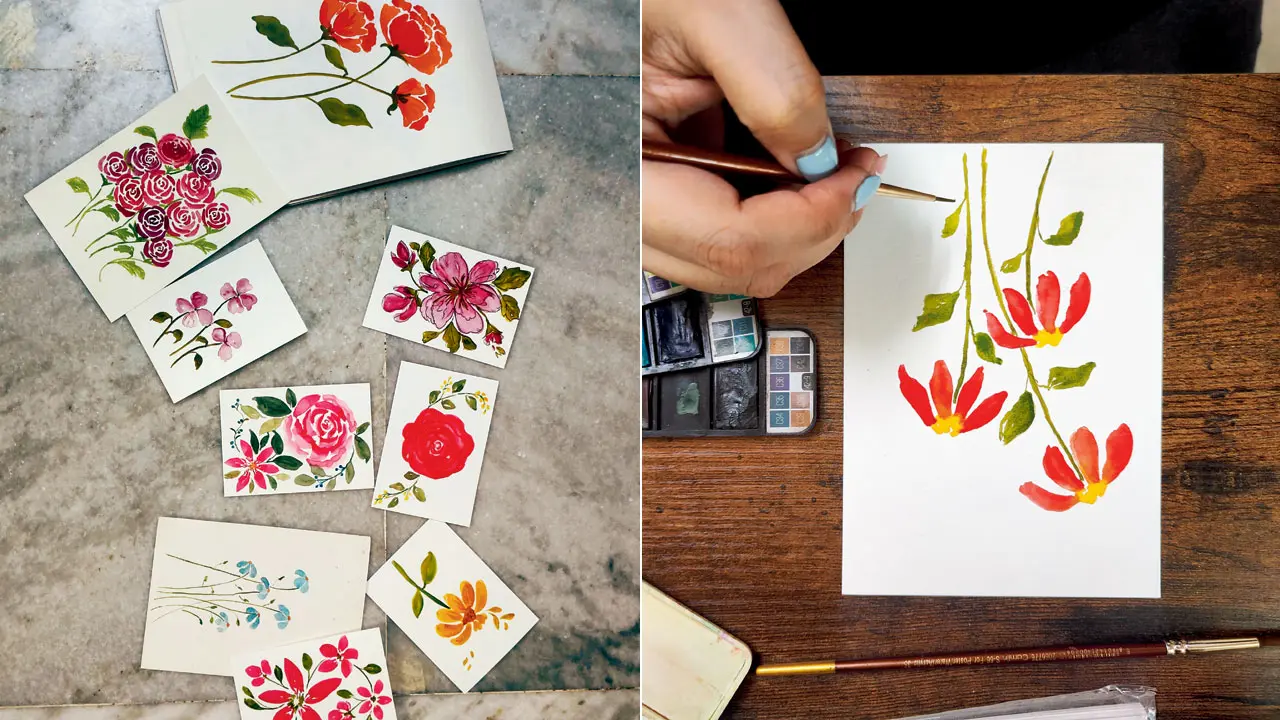
When I am painting, there is no time to think about unread emails or video meetings to jump into. It helps me unplug and unwind; (right) Some of the paintings I’ve made with watercolour paints
If you have ever sat down with a paint-by-numbers kit, you know the drill: You need to stay inside the lines; don't let the blue bleed into the pink. I say, you are creating art, not a crime scene. So, why so many rules?
For years, I tried to seek solace in structured creativity. Many mandala colouring books and numbered canvases later, I discovered, this isn't for me. I wanted the meditative benefits everyone raved about, but I always walked away feeling like a harried accountant balancing a ledger. "Five more blocks of paint number three, I better conserve it," I would think, as I would paint. It felt stressful, not meditative.
The pressure to match the reference photo, to be perfect, was just another checklist in an already frantic week. The world demands we stay within the lines at work, and in other daily obligations. My art became just another place where the correct outcome mattered.
Then, I discovered the liberation of loose watercolour florals.
Here's the secret: there is no pencil, no sketching, and absolutely no right way to do it. It is just my brush, some pigment, and the water. That watercolour sheet is the one sanctuary in my life where I can be completely unstructured without consequences. If a petal turns into a jagged, yellow blob instead of a delicate black-eyed susan (the most basic flower to paint), I don't see it as failure. It's just a reflection of my internal rhythm at that moment.
Studies published in the journals of the American Art Therapy Association suggest that engaging in creative activities reduces cortisol regardless of skill.
Unlike paint-by-numbers kits, which rely on executive function and task completion, loose painting promotes a flow state. By removing the constraint of a perfect outcome, you silence the inner critic that insists on precision.
The goal isn't to produce a masterpiece for an exhibition. You are simply producing a raw, unedited record of your presence in that exact moment.
I am not a great painter. My petals occasionally look more like drab, weeks-old lettuce leaves than botanical studies. But I don't paint to improve; I paint to unplug.
Instead of my eyes glued to a screen for hours, the tactile, analogue sensation of paper soaking up water is my digital detox.
It is intentionally messy. My fingers get stained; the water turns a muddy colour; sometimes I drip pigment on the paper. But that messiness is the price of peace.
There is no time to obsess over unread emails when you are watching a drop of crimson pigment bloom into a puddle of wet paper. You are forced to be present, focused entirely on the movement of your hand and the behaviour of the water.
. âCold-pressed watercolour paper: Choose paper with some texture, it's more forgiving than smooth printer paper.
. âTwo round brushes: A size 4 and a size 8 are all you need to create varied, organic petal shapes when you are starting out.
. âPrimary colours: Start with just three colours. Mixing your own shades can be meditative too.
. âTwo water jars: Keep one dirty for rinsing and one clean for picking up fresh pigment.
. âDitch the sketch: If you're terrified, start by painting simple, single strokes. The first mark is the hardest; let it be wobbly.
. âFollow the water: Watercolour has a mind of its own. When it flows outside your intended line or makes two colours blend, let it. That's the happy accident teaching you to release control.
. âCoordinate with breath: Exhale as you pull the brush down to create a petal. Inhale as you reload. Let your breath dictate the size and speed of your stroke.
. âEmbrace soggy lettuces: If your flower looks like a vegetable, laugh. Then paint another one right next to it. Have fun as you go.