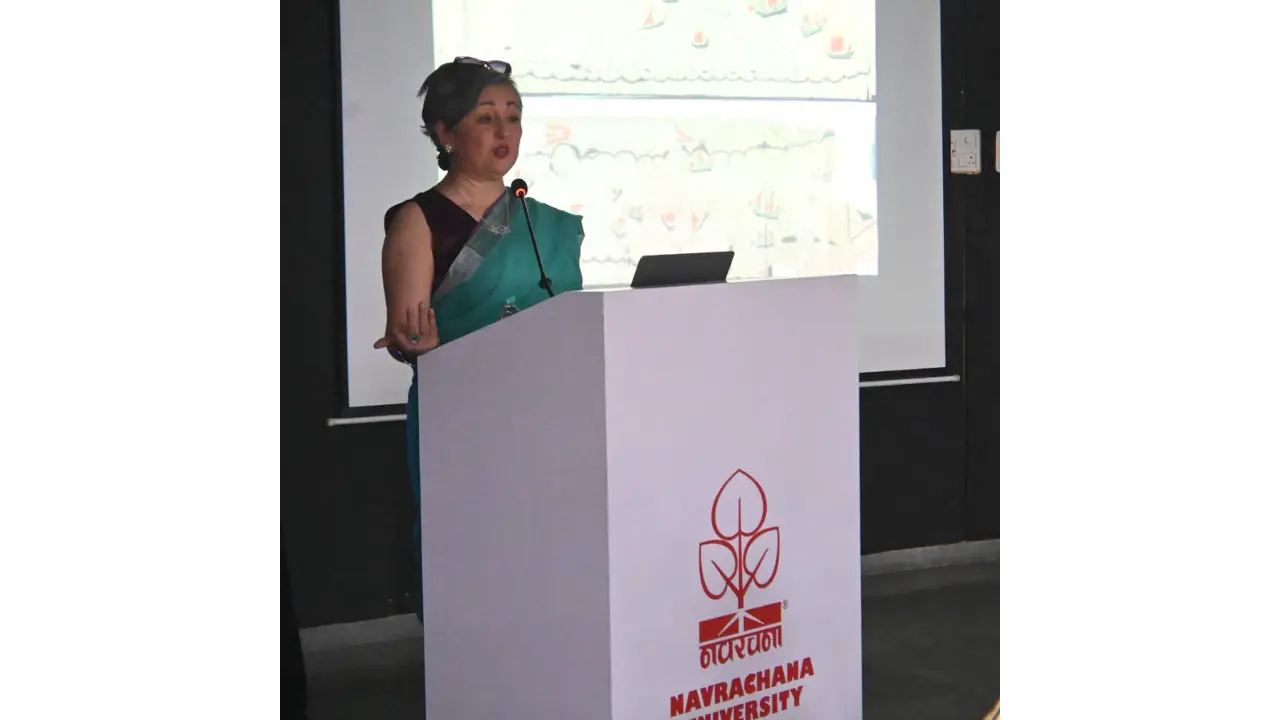
Navrachana University hosted Dr. Samira Sheikh’s lecture on Gujarat’s mapping traditions, highlighting its rich maritime and intellectual heritage.

Mapping the World from Gujarat” by Dr Samira Sheikh. First edition of the Parekh Lecture Series
Navrachana University, in collaboration with Heritage Trust, hosted an illustrated lecture titled “Mapping the World from Gujarat” by Dr. Samira Sheikh. The event marked the first edition of the Parekh Lecture Series at Navrachana University and was also presented as a Viraasat Lecture by the Heritage Trust.
Smt. Tejal Amin, Chairperson of Navrachana Education Society and member of the Board of Management, Navrachana University, said,
“Such lectures are very important for the city and society, as they bring in different disciplinary perspectives from history, arts, urban studies, and geography, at one place. I am very glad that Navrachana University, as part of the Parekh Lecture Series, has hosted this important lecture, and once again, I am very grateful to Lord Bhikhu Bhai Parekh for a generous book donation. I am sure Navrachana University will attract a lot of scholars who would come to our library to conduct research.”
The lecture was graced by Chief Guest Lord Bhikhu Parekh, in whose honour the Parekh Lecture Series has been instituted. Lord Parekh also generously donated his personal book collection to the Navrachana University Library, significantly enriching its academic resources.

Dr. Sheikh, Associate Professor of History at Vanderbilt University and the Obaid Siddique Chair (2025–26) at National Centre for Biological Sciences, Bengaluru, is also a distinguished alumna of the Navrachana campus. In her keynote lecture, Dr. Sheikh presented three central arguments that reframed the understanding of mapping traditions in India. First, she proposed that mapping should be understood as a living tradition and practice, rather than merely a technical or scientific product. Second, she highlighted Gujarati communities as historically active travelers and navigators whose trade networks extended across regions, including Afghanistan, East Africa, and South Asia. Third, she compared European scientific cartography with Indian mapping traditions, demonstrating how Indian maps often prioritized narrative detail, cultural context, and ecological knowledge over strict scale or proportion.
Through examples ranging from Jain cosmological diagrams and Mughal route scrolls to the sophisticated eighteenth-century nautical charts of Kutch, Dr. Sheikh illustrated the diversity of mapping traditions in India. She explained that while modern audiences often associate maps with standardized atlases or digital platforms such as Google Maps, earlier Indian maps frequently depicted landscapes through narrative elements, cities, temples, trees, animals, and water bodies, often accompanied by explanatory texts and travel instructions.
The lecture also brought to life remarkable historical tales, including that of a Buddhist mariner from Bharuch and the Yantraraja, an astronomical instrument used by Jain monks to measure latitude. Professor Sheikh also explained how Gujarati seafarers, including those who helped Vasco da Gama, relied on grid-based navigational systems and extensive botanical knowledge to travel across the Indian Ocean.
Highlighting a mid-eighteenth-century mural map preserved at the Baroda Museum and Picture Gallery, she demonstrated that Indian cartography represented a sophisticated synthesis of mathematical astronomy, artistic expression, and practical navigation. Dr. Sheikh concluded by urging audiences to view maps not as static objects but as dynamic processes of knowledge-making. By integrating Jain cosmological thought, Mughal administrative mapping, and the practical travel charts of merchants and sailors, Gujarat developed a unique knowledge system that sustained centuries of global trade and cultural exchange.

Reflecting on the insights shared during the lecture and Professor Sheikh’s association with the Navrachana campus, Provost Prof. Pratyush Shankar remarked,
“A map, much like science, cannot exist without a fair understanding of people and societies. It is not only about geography or history; it also speaks of economies, business, literature, and art. In many ways, maps bring together the entire domain of social sciences and humanities. Universities, therefore, remain incomplete without such interdisciplinary ways of understanding the world.”
The lecture offered audiences a renewed perspective on Gujarat’s intellectual and maritime heritage, reaffirming the region’s long-standing engagement with the wider world.
For more information - https://nuv.ac.in/
Subscribe today by clicking the link and stay updated with the latest news!" Click here!