When India fought for the British Raj
Updated On: 05 September, 2014 08:48 AM IST | | Kiran Mehta
A hundred years ago, India sent 1.5 million men to fight for WWI, the largest volunteer army the world had seen that year. We get access to Brighton’s Royal Pavilion, a palace of tremendous historic significance, which was transformed into an Indian military hospital





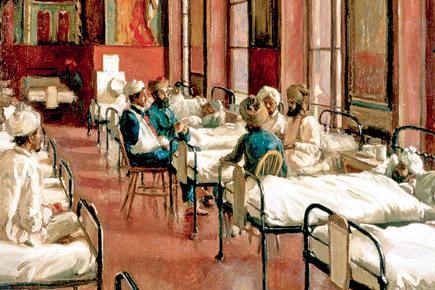
Indian military hospital
It was referred to as the ‘Great War’ and was all too idealistically coined ‘The war to end all wars.’ Fought on European soil, the First World War had super powers battle it out. Four empires fell — Germans, Habsburgs, Russians and Ottomans; while the British Empire, backed by its colonies, emerged stronger.

An oil painting by Charles Henry Harrison Burleigh. Shows two rows of beds occupied by wounded Indian soldiers in the Music Room of the Royal Pavilion during its use as a Military Hospital, 1915. PIC COURTESY/ Royal Pavilion & Museums, Brighton & Hove
India sent 1.5 million men to fight for the Raj, the largest volunteer army the world had seen in 1914; hundreds of Indian women served as nurses in Flanders, the Balkans, the Mediterranean and the Middle East; millions of rupees were spent in supplies and stores. But today, most in India can barely relate to war being far away from the epicentre. Remnants stand in Neuve-Chapelle Indian Memorial in France; the Gurkha Memorial, Horse Guards Avenue, London; the Brookwood Military Cemetery, Surrey.
One such reminder is Brighton’s Royal Pavilion, an opulent palace that was converted into a hospital for wounded Indian soldiers. To some, the space speaks of British benevolence to its subjects; to others it was a political move to placate Indian nationalism. Whatever one’s views, these walls whisper poignant human stories. Here’s a walkthrough of the space.
Trending Stories
Latest Photos
Latest Videos
Latest Web Stories
ADVERTISEMENT
Mid-Day Fast
ADVERTISEMENT