Why NASA's MAVEN mission matters
Updated On: 04 December, 2014 08:12 AM IST | | Hassan M Kamal
NASA’s Dr Jaydeep Mukherjee explains why it’s important that we understand Mars’ intriguing climate





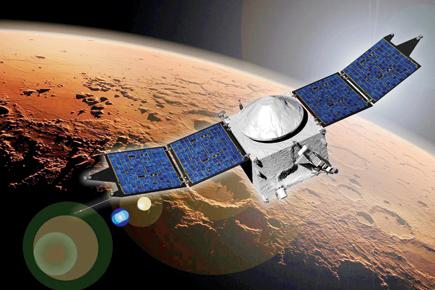
Mumbai Guide, Artist Concept of NASA, Mars Atmosphere and Volatile Evolution (MAVEN), Dr Jaydeep Mukherjee, interview, Mars
Q. Mars missions have always created interest among scientists as well as popular media (cinema, comics, novels, etc). Why is the red planet appealing?
A. To ancient civilisations, Mars was a deep red dot in the sky, a symbol of war and aggression. Telescopes in the late 1800s showed strange markings on Mars, which led people to believe that there were canals on Mars built by an alien race. People wondered whether these aliens were peaceful or were they planing an invasion on Earth. In 1938, a radio show called War of the Worlds led people to believe that Martians were invading Earth. At present, we know that there are no aliens on Mars and Mars is one planet where humans can go and settle in the future.

Artist Concept of NASA’s Mars Atmosphere and Volatile Evolution (MAVEN). Pic courtesy/NASA/Goddard Space Flight Centre
Q. How is NASA’s MAVEN (Mars Atmosphere and Volatile Evolution) mission different from the Indian Mars Orbiter Mission (MOM)?
A. The two projects are conducted for two different reasons. ISRO’s primary goal was to use MOM as a technology test bed for future missions. Their secondary goal was to obtain information on Mars with the help of five payloads, specifically, exploration of Mars’ surface features, morphology, mineralogy and Martian atmosphere by indigenous scientific instruments.
The NASA MAVEN mission was launched primarily to obtain information on the Martian atmosphere. MAVEN is the first spacecraft that will focus primarily on the state of the upper atmosphere and the overall atmospheric loss that is currently occurring. Specifically, MAVEN will explore the processes through which the top of the Martian atmosphere can be lost to space. This could be important in explaining the changes in the Martian atmosphere over the last 4 billion years.
Trending Stories
Latest Photos
Latest Videos
Latest Web Stories
ADVERTISEMENT

Ganeshotsav 2026

ADVERTISEMENT