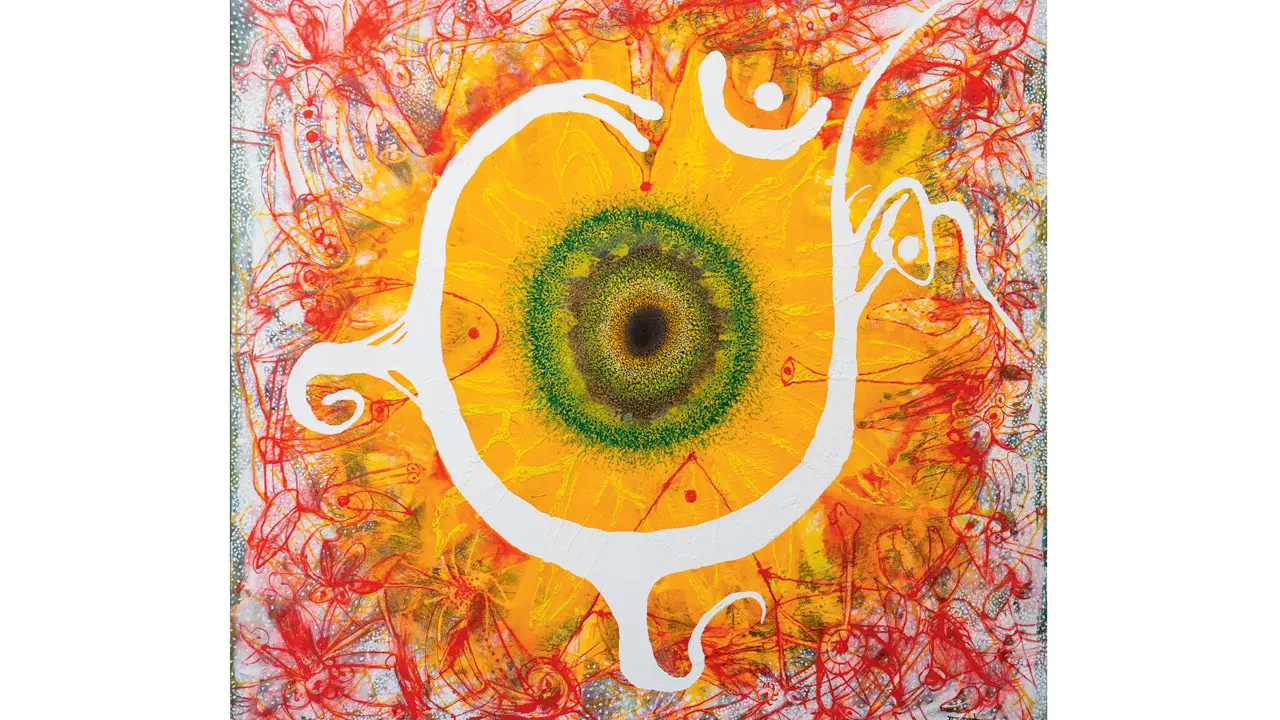
Spirituality, dynamic emotions, and an immersion of Indian life find expression in Padma Shri awardee Manu Parekh’s latest exhibition, Flower Sutra Part Two

Sunflower Sutra - I, 2025, Pics Courtesy/Artist; Nature Morte
He mentions it so casually that this writer almost misses it. It takes a second hearing to realise the gravity of the name. “It was during my interactions with the Hungry Generation of Poets in Kolkata during the 1960s, that Shakti Chattopadhyay introduced me to Allen Ginsberg,” says Manu Parekh. The 89-year-old is sharing his journey through art, and flower power. The latter forms a key motif that has informed his work, and does so in his latest exhibition, Flower Sutra Part Two.

Chanting with Colours 5, 2025
“The exhibition is a continuation of the series that opened in Delhi. Peter Nagy [curator, Nature Morte] and I agreed upon the name,” the veteran adds. The series brings to light the artist’s signature style where figures, forms, and intense energy emerges through expressionist abstraction. “Everything can be touched through figuration, or abstraction,” the Padma Shri- Awardee points out. And he does so by distilling them through a visual language defined by colour, symbolic motifs, and spirituality.
This experience traces back to his roots as a young child participating in Navratri decorations of Mohalla Mata (patron goddess; Malla Mata) in the Pols (traditional cluster of homes in a neighbourhood). He would witness Indian spirituality take centre stage in American counter-culture during his years at Sir JJ School of Art in the 1960s, and later travel to Kolkata; hang out with the Hungry Generation Poets, cinematographers like Subrata Mitra, and be introduced to a certain Allen Ginsberg. Each of these experiences informed his journey of art and life.

Sunflower Sutra - II, 2025
Yet, it is in Varanasi or Banaras that he found the symbol that defined it — the flower. He recalls walking down Dashashwamedh Ghat, watching a marriage being solemnised, to bodies being burnt at Manikarnika Ghat. “Banaras gave me faith and flowers. It reminded me how important faith is for the common man in this country. And flowers are physical representations of the journey of life,” the artist adds. It echoes the exhibition note, which reads, “Life, birth, marriage, and death: flowers will be there.”

This veering away from formalist definitions, and an engagement with rooted Indian philosophy defines his work. “These ideas affect your life deeply,” he explains. In his 80s, he continues to defy age. “Positivity has kept me going. As for painting, there is a poem by Sant Tukaram where he reveals Lord Vitthal ordered him to write a billion poems, and so, he writes. As an artist, I do not have a choice. I have to create
TILL April 4; 11 am to 7 pm (except Mondays)
AT Nature Morte, third floor, Dhanraj Mahal, Apollo Bunder, Colaba.
Subscribe today by clicking the link and stay updated with the latest news!" Click here!