Gaze at the vast galaxy that we call home, and learn all about deep sky objects, at limited-time observation sessions in Bhandardara

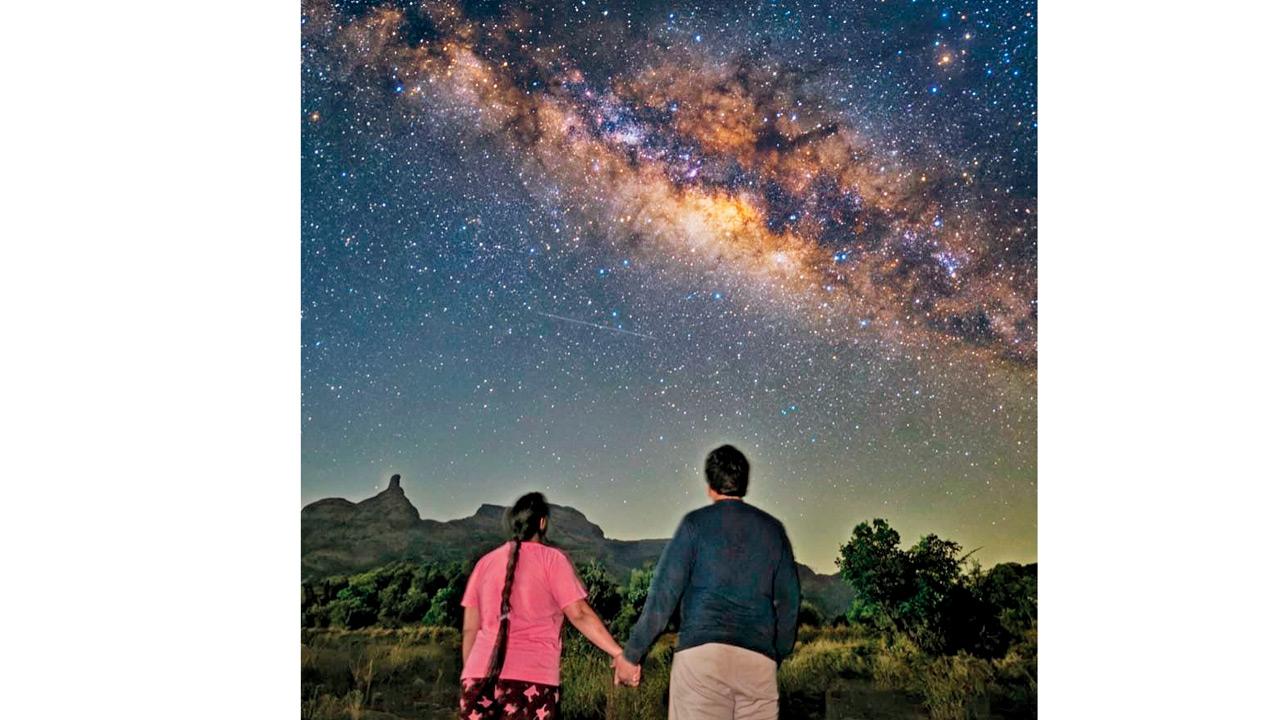
A couple looks up to a bright view of a section of Milky Way. PICS COURTESY/MIHIR GILBILE
If you know someone who needs an ego check, send them trekking to Bhandardara this weekend to marvel at the Milky Way, which spans 100,000 light years across its diameter. For context, the Sun that dwarfs us is just one of the at least 100 billion glowing stars in the spiral, disc-shaped galaxy.
In one pale blue dot that sits halfway from the core of this galaxy, astronomers like Mihir Gilbile find the perfect window from March to May to leverage the Earth’s relative position to the Sun, and look directly at the Milky Way.

C 63 Helix Nebula
This weekend, a guided tour will host enthusiasts for a space jam under the dark skies of Sandhan Valley in the Sahyadris. “Young enthusiasts today aren’t satisfied just by looking into a telescope. They want to know what they’re looking at, and what it is made up of,” says Gilbile, who leads the Horizon Astro Society.

Rho Ophiuchi cloud complex
The session includes a lesson on galaxies, a tutorial on night sky photography, and a constellation spotting activity. And then around 3 am, the sky deepens into its darkest hour, revealing the Milky Way in its luminous glory.

Orion Nebula
ON April 11, 18 and 25; 1.30 pm
MEETING POINT Dadar railway station or Kasara railway station.
CALL 8169167678
ENTRY Rs 1,999 onwards
Looking up
Here’s what the group of astro-enthusiasts has observed during previous expeditions

Mihir Gilbile
Chasing the stars
Rapid urbanisation is pushing astronomers in search of a clear view of the galaxy further away from the city. Mihir Gilbile reveals the true extent of the damage.

Andromeda, our nearest large galactic neighbour. PIC COURTESY/Sanchit Darves
>> Artificial light from industries and residential complexes leaking into the night sky makes it impossible to view lesser luminous celestial bodies.
>> Air pollution and suspended particles in the line of sight paint a hazy picture of what is actually a bright spectacle.
>> Over the last decade, the observation site has slowly shifted from Badlapur, to the remote Sandhan Valley, a shift of nearly 100 km, leading to an additional three-hour commute.
Subscribe today by clicking the link and stay updated with the latest news!" Click here!