While they collect and curate rare artefacts for auction, Todywalla Auctioneers is also a space to gaze at the rarities often hidden inside collector’s cupboards, as we found out during a recent walkthrough

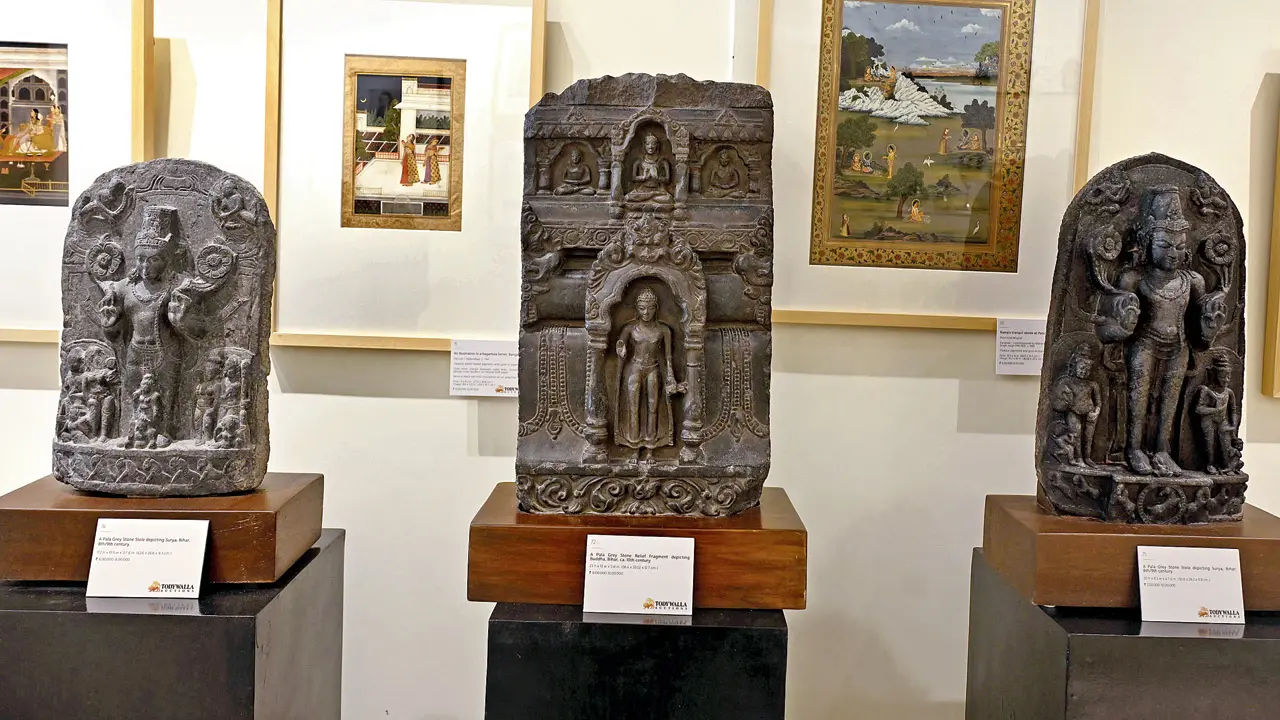
Three 10th Century Pala steles of the Buddha and two Suryas. Pics/Ashish Raje
The sweltering temperatures make the commute to Kemps Corner even more challenging. Yet, as soon as we enter the Todywalla Auction gallery, close to the old China Garden, it feels like a door into the past. Malcolm Todywalla is busy working on the details of the fourth auction from the house, Classical Indian Art, when we dropped by early last week.

A 10th Century bronze idol of Durga Mahishasura-mardini from South India
“My father [Farokh Todywalla] set up the auction house 55 years ago. We were mainly dealing in collectibles, coins, and antiquities among others, before expanding,” shares Malcolm. At the warehouse, the difference is noticeable, emphasised by the rare artefacts and paintings that mark the space.
The auctioneers spend over a year gathering the provenance, and background checks before each auction. Each addition to the catalogue is carefully vetted, and curated to a theme. “Our collections have a planned chronology. The Journey through Classical Indian Art auction, for instance, had paintings, sculpture, Indian silver, and jewellery that represented art from the whole country,” he shares.

Malcolm Todywalla
While auctions are not everybody’s cup of tea, Todywalla notes that one can always browse through these works, before they go under the hammer. “We hope that more people learn, and walk in to get a glimpse of such rare artefacts, as they might hardly have another opportunity,” he points out.
At Todywalla Auctions, Om Chambers, Kemps Corner, Babulnath, Tardeo.
Call 8169542596 (to schedule a visit)
Bronze figure of Vishnu, C 8th/9th Century AD

Todywalla reveals, “Stone sculptures are more likely to survive than bronze idols. The latter were used in daily worship, and wither away with time due to daily usage.” This rare bronze traces its roots to the region that is today’s Himachal Pradesh.
Bust of Male deity (Vishnu), C 10th Century AD

This large sandstone bust is decked with ornately carved tiara and necklace. Pointing to the two and half feet tall bust, Todywalla remarks, “Imagine the size of the entire standing statue.”
Silver stemmed bowl, C 1880-1890

Ornate, and in kashkul form, “the etching of the leaves of the Chinar tree on the bowl are a running motif in silver from Kashmir,” Todywalla reveals.
Ganga on a Makara, C 10th/11th Century AD

This sandstone carving hails from Central Indian plains. Probably part of an ornamental arch, it depicts the goddess Ganga riding a makara.
Kushan lion, C 2nd to 3rd Century AD

With gaping jaws, protruding teeth, the sandstone Kushan Lion, tracing its origins to Mathura, closely resembles the Winged Lion Capital now at the Victoria and Albert Museum, London.
The battle of Rama and Ravana, C 1840

This Kangra work captures the chaos and dynamism of the climactic battle through a dense, but intensely detailed canvas.
Subscribe today by clicking the link and stay updated with the latest news!" Click here!