Home / Mumbai / Mumbai News / Article /
How UAPA helped arrest ex-JNU student leader Umar Khalid
Updated On: 20 September, 2020 07:15 AM IST | Mumbai | Gaurav Sarkar
Fifteen of the 23 arrested in connection with an alleged conspiracy behind Delhis February riots have been chargesheeted under the widely-criticised Unlawful Activities (Prevention) Act, 1967





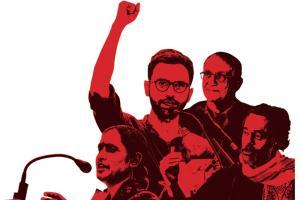
Kavita Krishnan, Umar Khalid, Harsh Mander and Yogendra Yadav. Photo imaging/Uday Mohite
After being interviewed for almost 11 hours, ex-student leader of Jawaharlal Nehru University (JNU) Umar Khalid was arrested in the national capital last Sunday by the Delhi Police's Special Cell. He was booked under various sections of the Unlawful Activities (Prevention) Act, 1967, as well as for murder and sedition under sections of the Indian Penal Code (IPC). His arrest stems from the Delhi Police's investigation into FIR 59/20, which deals with an alleged case of "planned conspiracy" behind the riots that rocked North East Delhi in February this year, leaving 53 dead, and over 400 people injured over a period of three days. The Delhi Police's investigation has led to the arrest of 23 persons, who, they claim, were part of a "systemic mobilisation of the crowd to incite violence in the garb of anti-CAA protests." Fifteen of these 23 have been charged under the UAPA, based on "technical evidence" such as WhatsApp chats, which take note of the pattern of traffic jams at anti-CAA protest spots, and interpret it as "the first indicator that there was a conspiracy" due to which the riots erupted.
Last Monday, Khalid was remanded to 10 days of police custody by a Karkardooma district court. Leaders such as Yogendra Yadav (national president of Swaraj India), human rights activist and peace worker Harsh Mander, Kavita Krishnan (CPIML Politburo Member) and others who played a vital role during the peaceful anti-CAA movement last year—and most of whom have themselves been named in disclosure statements by the Delhi Police—condemned Khalid's "witch hunt" under the draconian UAPA. "With deep anguish, we have no doubt in saying that this investigation is not about the violence in February 2020...but on the completely peaceful and democratic protests across the country against the unconstitutional CAA," said one such statement.
Trending Stories
Latest Photos
Latest Videos
Latest Web Stories
ADVERTISEMENT
Mid-Day Fast
ADVERTISEMENT