Home / Mumbai / Mumbai News / Article /
Meet the 11 docs helming the state's tactical fight against pandemic
Updated On: 21 June, 2020 07:02 AM IST | Mumbai | Jane Borges
From planning Mumbai's field hospitals, to expanding ICU bed facilities and finding the perfect drug combination to tackle COVID-19, these members of the CM appointed task force are keeping state's mortality rate to 3.2 per cent



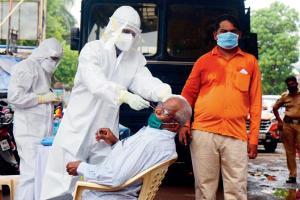
A doctor seen taking a swab sample at a Coronavirus testing drive inside Dharavi. The COVID-19 task force has been pushing for aggressive community screening. Pic/Suresh Karkera
Compassionate, prudent and sympathetic. This was the three-pronged strategy adopted by the Bombay municipality in the September of 1896, when Dr Accacio Gabriel Viegas, a member of the Bombay Municipal Standing Committee diagnosed the first case of bubonic plague in the city. In an attempt to avoid "affliction and panic", the municipality chose a rather unusual—and what they thought to be sensitive—means to tackle the disease. "They lit street fires to rid the air of plague germs, and roofs of homes were opened to inspect water and drain connections. Houses where plague deaths had occurred were marked with the letters, 'u.h.h.' (unfit for human habitation)," says academic and medical historian Mridula Ramanna, who researched the epidemic for her 2012 book, Health Care in Bombay Presidency, 1896-1930. But these measures failed to pass muster, and by March of the following year, the city had recorded nearly 33,161 deaths.
It was the government-appointed Bombay Plague Committee that took charge soon after, which began the fight against the disease in full earnest. Headed by General William Forbes Gatacre, the committee's forced examinations, segregations in hospitals and camps and inoculations, were unfortunately, seen as both, intrusive and brutal, by the colonial subjects, says Ramanna, in a telephonic interview. It also triggered a riot in Madanpura in March 1898, when "a Parsi medical student, a Eurasian nurse and the plague officer of the ward, were refused admission into a house to examine a suspected plague case of a 12-year-old girl". Despite being unpopular, Gatacre and team were central to the conversation around the deadly plague, lauded for implementing measures like isolation, which continue to hold water, even a century on, as the city grapples with the Coronavirus pandemic.
How do you like the new new mid-day.com experience? Share your feedback and help us improve.
Trending Stories
Latest Photos
Latest Videos
Latest Web Stories
ADVERTISEMENT
Mid-Day Fast
ADVERTISEMENT

ADVERTISEMENT