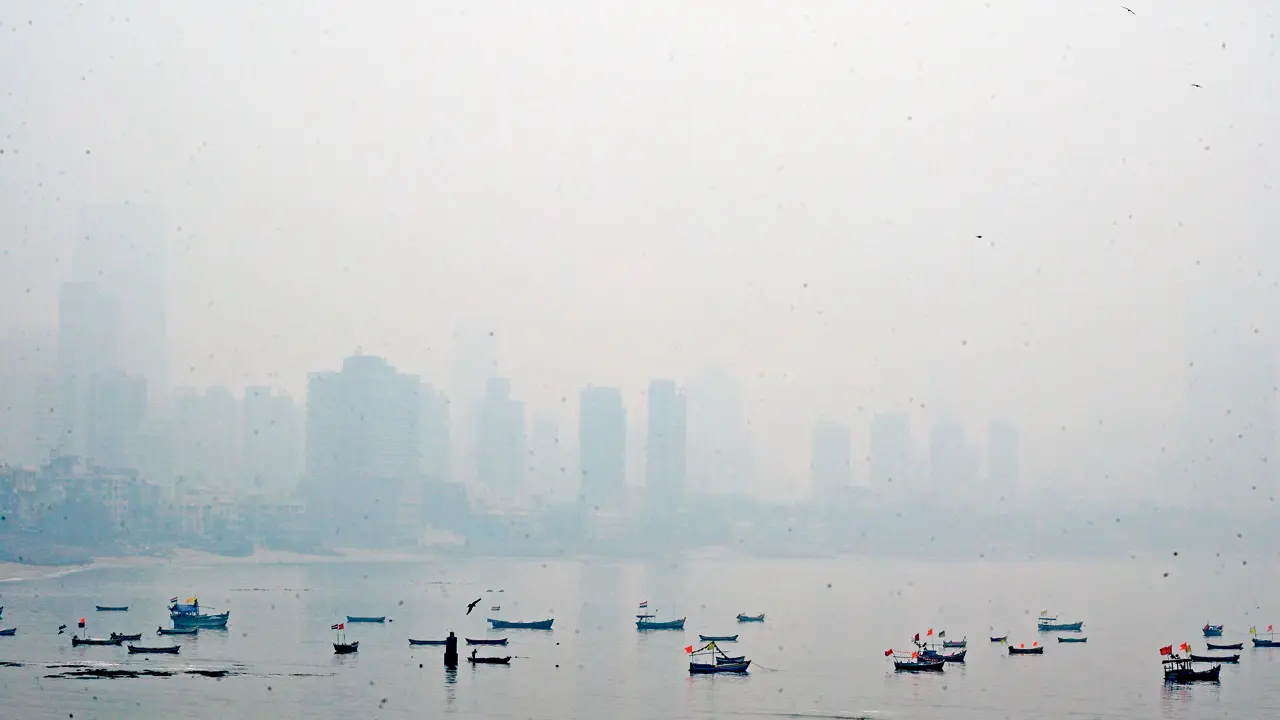
Despite visible haze and low visibility across Mumbai, AQI readings remain largely satisfactory or moderate, prompting residents and experts to question whether AQI alone reflects real-time air quality and health risks

A veil of haze shrouds the western shores of Mumbai on March 12. PICS/SHADAB KHAN
While hazy skies and low visibility have become a common sight for Mumbaikars these days, the numbers on air quality index (AQI) monitors across the city keep telling a different story. If these devices are to be believed, Mumbai’s air quality was largely satisfactory (51-100) or moderate (101-200) in the past few days.
Yet commuters, who witnessed notable haze in the early hours of Wednesday, are sceptical about these readings. “I live on the 19th floor, and the air outside has been hazy for a few days. While I have an AQI app on my phone, air visibility is the first parameter I go by,” said a Bhandup resident.
![A digital signboard at a construction site in Kalanagar, Bandra East. Asked about the apparent discrepancy in readings of AQI monitors at such sites and visible phenomena, a senior BMC official said these kinds of AQI monitors only measure air quality within a radius of four to five metres. “Citizens can use the SAMEER app [operated by the Central Pollution Control Board] to check the ambient AQI in their vicinity. Its monitors measure air quality within an approximate radius of 2 km. We are also looking at installing 125 reference-grade monitors at construction projects of over 1000 crore around the city,” he said](https://images.mid-day.com/images/images/2026/mar/AQI-board_e.jpg)
A digital signboard at a construction site in Kalanagar, Bandra East. Asked about the apparent discrepancy in readings of AQI monitors at such sites and visible phenomena, a senior BMC official said these kinds of AQI monitors only measure air quality within a radius of four to five metres. “Citizens can use the SAMEER app [operated by the Central Pollution Control Board] to check the ambient AQI in their vicinity. Its monitors measure air quality within an approximate radius of 2 km. We are also looking at installing 125 reference-grade monitors at construction projects of over 1000 crore around the city,” he said
On Wednesday, however, the AQI readings for several locations — Worli (MPCB), Vile Parle (MPCB), Mazagaon (IITM), and Chembur (MPCB) experienced satisfactory AQI while Bandra Kurla Complex (MPCB), Deonar (IITM), and Chakala in Andheri East (IITM) — were within the moderate range. Observing this contrast, citizens are left wondering which parameter one should go by before deciding to take a morning walk or send their children downstairs to play.
Expert Speak

Sumaira Abdulali, founder, Awaaz Foundation
‘The AQI readings remained moderate around the city, but we saw a notable dip in the visibility, which was possibly due to moisture. Such days make you think whether a sole AQI reading is a proper parameter to decide, especially when it depends on a mix of various factors, including PM10, PM2.5, and NO2. Citizens would like things to be simplified and be alerted to health risks on a given day, rather than plain AQI numbers’
Bikram Singh, regional head, RMC Mumbai
‘Southeasterly winds in lower levels and anticyclonic circulation in middle tropospheric levels are responsible for the low visibility the city was experiencing in the past few days; however, it has already begun clearing up. The pollutants and moisture had stagnated and added haziness to the air, reducing visibility. With changing winds, the pollutants will lift, and the air is expected to clear up in the coming days. All in all, the AQI can help you assess the pollution, while the visibility can be controlled by meteorological factors’
Gufran Beig, chair professor, National Institute of Advanced Studies founder, System of Air Quality and Weather Forecasting And Research
‘Under warmer temperatures, dust originating from the Thar desert gets lifted and moves towards the western coastal belt. This activity is becoming more intense due to the transition from La Niña to El Niño, a climatic phenomenon. Also, the western disturbances inject a lot of moisture into the air below. So when pollution meets moisture under stagnation conditions, a haze-like situation appears. The lack of visibility can be attributed to stagnant pollutants and moisture’
Subscribe today by clicking the link and stay updated with the latest news!" Click here!