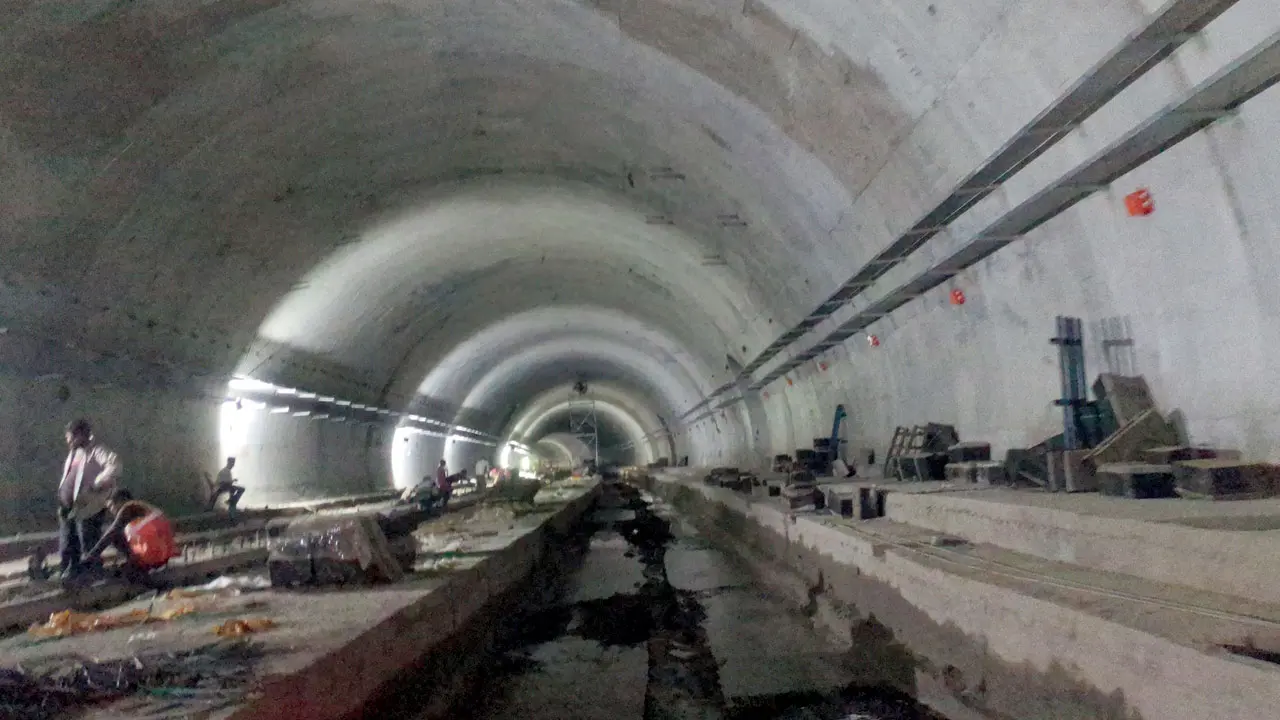
Apart from tunnel measuring record 2.6 km, Panvel-Karjat corridor boasts of suburban section’s first ballastless track and aqueduct

The new Panvel-Karjat railway line. Pics/Rajendra B Aklekar
A brand-new suburban railway line connecting the harbour line (Panvel) with the main line (Karjat) of Central Railway — designed to decongest Mumbai’s existing overcrowded corridors — will also facilitate connectivity with the Navi Mumbai International Airport. This will be Mumbai suburban railway’s sixth corridor after the main, harbour, trans-harbour, and port lines (all of CR), and the western line. According to officials, to ensure those residing in a cluster of houses at Chowk that came in the path of the new rail line weren’t displaced, the alignment was tweaked a bit, preventing the dismantling of the structures.

Karjat platform
The new Karjat integrated suburban terminal has six platforms and five lines. It is 330 metres long, and the platform is 15-car ready. In the long run, this station will not only cater to the Karjat-Panvel line but also be a part of Karjat-CSMT operations.
The 2.6 km tunnel, which has refuge areas every 50 metres in case of emergencies
One-of-a-kind aqueduct
At a point near Chowk, a lot of downstream water was crossing over the rail lines. An aqueduct — a water-carrying structure where a canal/stream is taken over the railway line —has been built for easy passage of water. This is the first such structure on a Mumbai suburban railway

Footbridge for tribal residents
The only foot overbridge on the line between stations (mid-section) is at Baravli. The structure replaces an old, small bridge and has been built to facilitate movement between tribal hamlets on one side of the line and farms on the other.

Ballastless track
Inside the three Panvel-Karjat tunnels, the suburban line will use a slab track instead of the usual stone ballast. The rails are fixed directly to a reinforced concrete base, which stays stable in confined underground conditions, needs far less maintenance, and provides a smoother, more reliable ride for trains through the nearly 2.6-km tunnel. This is also a first for the suburban section.

Ancient temple on alignment
While laying the new railway line, the MRVC team came across the remnants of an ancient Shiv temple with a Nandi shrine next to an open field near Nadhal. Though there are very fragments of the structure, a Nandi idol stands tall amid the ruins. A senior railway engineer has updated Google Maps with
the details.

Line facts
Total length
29.6 km
Estimated cost:
Rs 2780 crore
Electrification:
25 kV AC
Purpose:
New suburban commuter route (EMU locals)
Tracks
Double-line suburban corridor
Maximum design speed:
~110 km/h class suburban operation
Completion date
2026
Teen sawaal with the Chief Project Manager Yogesh Sharma

1 What has been the most challenging part of the project?
Working in the Sayhadri hills, including excavation and removal of debris from the difficult terrain. There are rock and mountain cuttings, the deepest being 25 metres. There are two rail flyovers at either end. The monsoon poses challenges.
2 What are the salient features of the longest tunnel?
The tunnel has refuge areas every 50 metres for emergencies, a complete through walkway, ballastless tracks which offer a large lifespan for tracks and keep them maintenance-free. The tunnel has jet fans every 200 metres. The tunnel lining has been covered with mesh after shortcreting, and then there is a layer of membrane so that water does not permeate inside.
3 What are the project’s key features?
Extensive rock cutting and earthwork, ballastless track inside tunnels, a key bridge over the Mumbai-Pune Expressway, and complex yard modifications at Panvel and Karjat executed without disrupting train services, showcasing advanced engineering and strict environmental management in
forested zones.
Subscribe today by clicking the link and stay updated with the latest news!" Click here!