Home / News / India News / Article /
Vedic thunder, rain and frogs
Updated On: 26 August, 2018 06:47 AM IST | | Devdutt Pattanaik
Poetry and metaphor is used to connect the physical and psychological world. Inspiration is used to evoke the gods. There is no real story to tell. Just a description of life, of nature





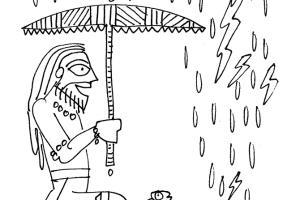
Illustration/Devdutt Pattanaik
%20(1).jpg "Devdutt Pattanaik") Parjanya is the Vedic god of rain and thunderstorms. We don't remember him anymore. But Mandala 5, verse 83, is a beautiful song describing and praising him. The thunder and lightning that smashes trees are equated with the lashing whips of a charioteer. The rain is imagined as planting embryos of plants on the earth. He is imagined as a bucket of water upturned, who levels the highlands and the lowlands. He fills the watering holes and brings forth juicy pasturelands for the cows. But in the final verse, the poet asks the rain to stop, after he has done watering the earth, bringing forth plants, and inspiring those who watch him fall. Thus, this poem that is over 3,000 years old, composed in Vedic Sanskrit, captures the emotion of all people who love the rain, until it becomes unbearable, and then we want it to stop.
Parjanya is the Vedic god of rain and thunderstorms. We don't remember him anymore. But Mandala 5, verse 83, is a beautiful song describing and praising him. The thunder and lightning that smashes trees are equated with the lashing whips of a charioteer. The rain is imagined as planting embryos of plants on the earth. He is imagined as a bucket of water upturned, who levels the highlands and the lowlands. He fills the watering holes and brings forth juicy pasturelands for the cows. But in the final verse, the poet asks the rain to stop, after he has done watering the earth, bringing forth plants, and inspiring those who watch him fall. Thus, this poem that is over 3,000 years old, composed in Vedic Sanskrit, captures the emotion of all people who love the rain, until it becomes unbearable, and then we want it to stop.
In Mandala 7, there are more songs to Parjanya. There is a complex hymn 101, and a very straightforward hymn 102. In the complex hymn, the rain-god is sexually ambiguous: sometimes barren, sometimes planter of embryos, sometimes called the father whose milk is consumed by the mother, to bring forth the son. He is the lord of the moving (animal) world and the immobile (plant) world. He brings forth milk and honey and embryos in all plants and animals. His celestial nature is celebrated by reference to three: three worlds, three stages of flowing water, three speeches, and even three buckets. In the straightforward hymn 102, honeyed oblation is joyfully made to the rain-god who fertilises plants, cows, horses, and women, who creates pastures and refreshes the earth.
Trending Stories
Latest Photos
Latest Videos
Latest Web Stories
ADVERTISEMENT
Mid-Day Fast
ADVERTISEMENT