Home / News / World News / Article /
Mask ban protest sparks street fights, clashes and vandalism
Updated On: 07 October, 2019 11:12 AM IST | | Agencies
"There is no going back, we are at the point of no return." Patricia Anyeung, who described herself as a wealthy retiree with a UK passport, said she may leave if Hong Kong's freedom is extinguished



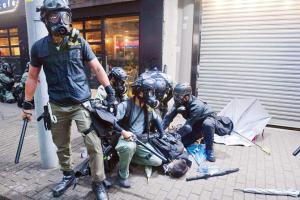
Police detain a protester in Wanchai district on Sunday. Pic/AFP
Hong Kong: Shouting "Wearing mask is not a crime," tens of thousands of protesters braved the rain Sunday to march in central Hong Kong as a court rejected a second legal attempt to block a mask ban aimed at quashing violence during four months of pro-democracy rallies. The ban took force Saturday, triggering more clashes and destruction over the last two days in the semi-autonomous Chinese territory. A teen protester was shot Friday night in the thigh after an off-duty police officer fired his pistol in self-defense. Lawmaker Dennis Kwok said the High Court refused to grant an injunction on the mask ban, but it agreed to hear later this month an application by 24 legislators against Hong Long leader Carrie Lam's use of emergency powers to impose the measure by circumventing the legislature.
The embattled leader has said the ban on masks, which allows radical protesters to conceal their identity, was needed to stop widespread violence that "semi-paralyzed" the city. It is also the biggest challenge for Chinese President Xi Jinping since the former British colonial returned to Chinese rule in 1997. Many malls, shops and the entire MTR network of subways and trains shut Saturday following the overnight rampage. About half of the city's 94 subway stations reopened Sunday but many malls, especially in the Causeway Bay shopping district, remained shuttered as thousands of protesters marched with umbrellas and most of them wearing masks in defiance. Critics fear the use of the Emergency Regulations Ordinance that gives Lam broad powers to implement any measures she deems necessary in an emergency would pave the way for more draconian regulations. The law was enacted by British colonial rulers in 1922 to quell a seamen's strike and last used in 1967 to crush riots. Lam has not ruled out further measures if violence continues.
Trending Stories
Latest Photos
Latest Videos
Latest Web Stories
ADVERTISEMENT
Mid-Day Fast
ADVERTISEMENT

ADVERTISEMENT