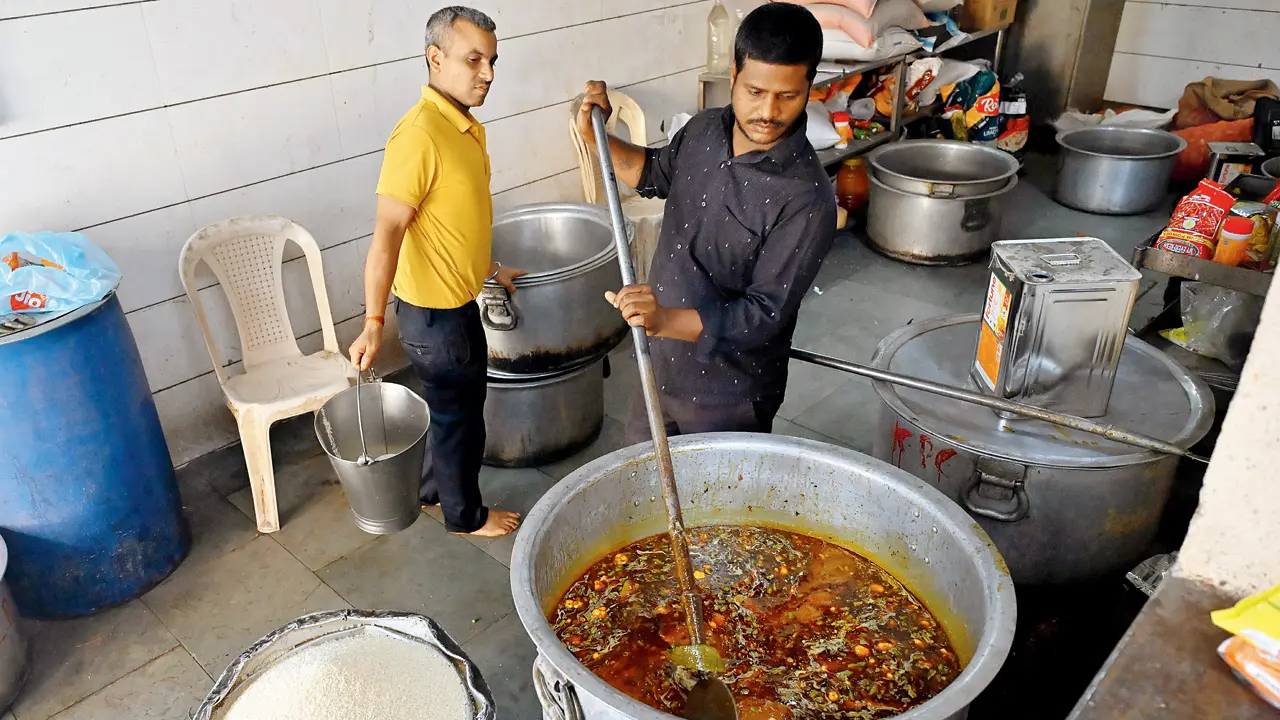
The city’s food banks, madrassas, and langars bravely carry on their mission to feed the poor and hungry, even as each day brings the same question: LPG kaha se milega?

Bhau Parsram Jhulelal Mandir prepping for the Cheti Chand langar on Friday. PIC/SAYYED SAMEER ABEDI
Need doesn’t mean the same thing to everyone. For most in the country who are rushing to buy induction stovetops, or paying four to five times more for LPG cylinders in black, their need is hoarding extra security for themselves. In some kitchens, though, when the stove goes cold, need manifests as hundreds of growling bellies that may not get another meal for days to come.
We live in an era where cooking is never thought of as a luxury, and yet so many have neither a roof above their head, nor the agency to feed themselves. Forgotten by society and system, their only hope is a few heroes without capes — running food banks, langars, and charitable hostels — who have vowed to never let the city’s poor go hungry.
India ranks 105th out of 127 countries in the Global Hunger Index from 2024. With a score of 27.3, the index has categorised hunger as a “serious” situation in the country. It’s a sobering reality that we must be cognisant of as we whine about limited restaurant menus, skyrocketing black market rates for LPG cylinders, and inflated air fares for our summer vacation.
‘Gareeb vechara kithe khayeenda?’
Lilaram Mulchandani
Temple head at Bhau Parsram Jhulelal Mandir, Ulhasnagar, which serves twice-daily langar
At Bhau Parsram Jhulelal Mandir in Ulhasnagar’s Camp 2, the kitchen promises to serve two meals a day to anyone who walks in. It’s a simple meal with sabzi, roti, dal, and rice — comfort food served with the assurance that no empty stomach will be turned away. That promise, though, is at risk of being broken.
“At any given point in time, we use three cylinders a week,” temple head, Lilaram Mulchandani, explains that this supply encompasses the gaushala, the bhandara, and the needs of priests and staff. On festive days, the demand rises to four.

Staff prepare food at Al Jamia Faqihatul Banat, a madrassa in Malad. PIC/ATUL KAMBLE
On Friday, when the Sindhi community celebrated one of its biggest festivals of the year, Cheti Chand, marking both the Lunar New Year and the birth anniversary of Lord Jhulelal, the temple was stretched to its limit. With unreliable LPG supply, Mulchandani found himself negotiating, borrowing, and collecting any cylinders available anywhere. They are yet to break their promise. An average of 300 people daily, and thousands on festive days turned up for the langar. Not a single person was turned away. The effort is driven by a simple motto: the poor shouldn’t starve. Mulchandani says, “We offer two meals a day, and anyone is welcome to come eat. This is the prasad from the temple.”
Adaptation has now become a necessity. While Cheti Chand was a special occasion marked with vegetable biryani cooked in batches of 50 to 60 kg for lunch and dinner, other days are marked by jugaad. Rotis, once cooked on gas, are now being prepared more laboriously with rare devotion on a coal-fired sigdi to conserve LPG. “There’s a lady at the temple who makes rotis and tea for the staff. We have had her swap to a sigdi as well,” he adds. For the barsi of Bhau Parsuram on March 14, Mulchandani secured seven to eight cylinders, some of which are still in use. Three more are in storage — nowhere close to the 15 the temple requires to cover the entire month.
“I have been doing my best to try to arrange more cylinders. Even if they are half-full, I will take them,” Mulchandani says. He is now trying to secure an electric stove. Until then, his question remains, “Gareeb vechara kithe khayeenda? [Where will the poor go to eat?]”
No of meals fed daily: 600
Monthly LPG requirement: 15
Current status: Moved partially to coal
Food NGOs losing out on catering support
Nidhi Sanghai
Mumbai city representative, Robin Hood Army (food NGO)
For volunteer-driven food banks like the Robin Hood Army (RHA), which operates across 400-plus cities, the ongoing LPG shortage is beginning to disrupt subtly, but significantly, through the food donation chain.
The impact isn’t drastic yet, but there are early signs, says RHA’s Mumbai city representative, Nidhi Sanghai, who coordinates the collection of surplus food from restaurants and also outsources the cooking of donated food grains.

The weekly food donation drive by Robin Hood Army
“The effect is not obvious, but yes, there is an impact, albeit a limited one, on leftover food from restaurants and parties,” she says. With restaurants cooking less or shutting down temporarily due to LPG constraints, surplus food — the backbone of RHA’s operations — has seen a dip. “In the past two days, I’ve noticed fewer calls for excess food pickup,” she adds.
The uncertainty extends to sponsor-backed vendors or caterers who cook donated grains for RHA as well. “We’ve heard that one or two vendors have shut down operations. Others who had paused earlier, are now restarting. We’ll have more clarity after this week,” Sanghai explains. While RHA’s scale allows it to work with multiple vendors across locations, any disruption directly affects how much food reaches a plate. “It will affect the quantity of each serving,” she adds. “Depending on the excess food donations, and what the caterers provide, we mainly have a plate of rice, dal or curry, and sometimes sweets and fruits.”

Nidhi Sanghai
To stay ahead of a potential escalation, the group is already preparing contingencies. “As a backup, we’ve planned to distribute packed or dry food if vendors are unable to provide cooked meals.”
No of people fed weekly: 4000
Current status: Few of their caterers have paused kitchen operations
‘Hunger cannot wait’
Jayendra Tambe
Operations manager at Roti Bank Foundation (food bank)
Roti Bank Foundation is being forced to make difficult compromises without slowing on its mission. Founded in 2017 by former Maharashtra DGP D Sivanandhan, the NGO provides food to the poor in areas like Mankhurd, Byculla, as well as to schools, other NGOs, and to families of patients outside Tata Memorial Hospital in Parel. It has served over 26 million meals since its inception, working with a simple principle that “hunger cannot wait”.

Jayendra Tambe
What first began as a food bank to distribute surplus food has since evolved into a full-scale kitchen operation in Chembur, feeding 18,000–20,000 people daily across Byculla, Mankhurd and nearby areas. “We need nine cylinders a week, and utilise almost three in a day, but now get only one or two daily,” says operations manager Jayendra Tambe.
The impact is visible on plates. Cooked snacks for children like poha and upma have been replaced with dry snacks. “The portion for sabzi that we serve with rice and dal is down to a quarter of the original serving,” he rues, “Quantity has suffered, but we don’t plan on stopping.”
For Sivanandhan, rising costs and supply gaps are secondary concerns. “Whatever the problem, our poor people should not be deprived of anything that an average Indian meal includes,” he asserts, “Even if it is a little expensive for us, we have to adjust.” With no government backing, the NGO has absorbed the rising costs and logistical strain through donations. But it’s an example of how fuel shortage poses a direct threat to food security for the urban poor.
No of meals fed daily: 18,000
Weekly LPG requirement: 9
Current status: LPG supply down to a third
‘Baccho ko kya khilaye?’
Mohammed Shahid Sabri Vice principal, Al Jamia Faqihatul Banat, a madrassa in Malad
The doors of Al Jamia Faqihatul Banat, a madrassa tucked in a corner of Malvani in Malad West, are to reopen back on March 28, once students return from Ramzan break. Its kitchen will need to resume thrice-daily prep of meals for its 550 student residents and 32 staff members at the hostel. That’s 1800 meals through the day in total.

A few of the students currently studying in Al Jamia Faqihatul Banat. PICS/ATUL KAMBLE
Mohammed Shahid Sabri says that currently, their kitchen can barely manage to feed the 20-odd students and staff members who have stayed back on campus. “We got a few cylinders from Goregaon; some people gave them to us out of the goodness of their hearts. But when the students come back after Eid, baccho ko kya khilaye?” he says.
“Parents have begun to call us, worried if we will be able to manage food for all the children,” he says. Many of the students — aged six to 15 — hail from working class backgrounds and travel from far-flung areas across the state to the madrassa, which offers education, boarding and food at a nominal cost.
“Many students book their train tickets months in advance. Any deviation in plan would mean waiting it out to re-book tickets, losing out on studies. Or, they come back to an unreliable supply of food,” he adds. Sabri says most madrassas in Malvani are facing a similar crisis. “If they don’t come back, we will have to rush through the curriculum to catch up. We are at our wits’ end,” he adds.
No of meals fed daily: 600
Monthly LPG requirement: 25-30
Current status: Considering a delay in reopening post Eid break
Economist speak
Developmental economist Ritu Dewan says, “Not anticipating this problem for charitable institutions providing food to the hungry is a failure in governance. Also, Mumbai has been in the eye of famines like during the 1962 Indo-China war, and we have seen a less than empathetic policy response in during demonetisation and the COVID pandemic. I hope India can figure out how to make sure that the most vulnerable populations do not go hungry.”
That characteristic rotten-egg odour of LPG? It’s a safety feature! The smelly ethyl mercaptan compound is added to LPG make gas leaks detectable
Subscribe today by clicking the link and stay updated with the latest news!" Click here!