International schools students are thought to have an edge with their global knowledge. And yet, with local context missing from curricula, one has to ask: Is life abroad and not in India, the only goal?

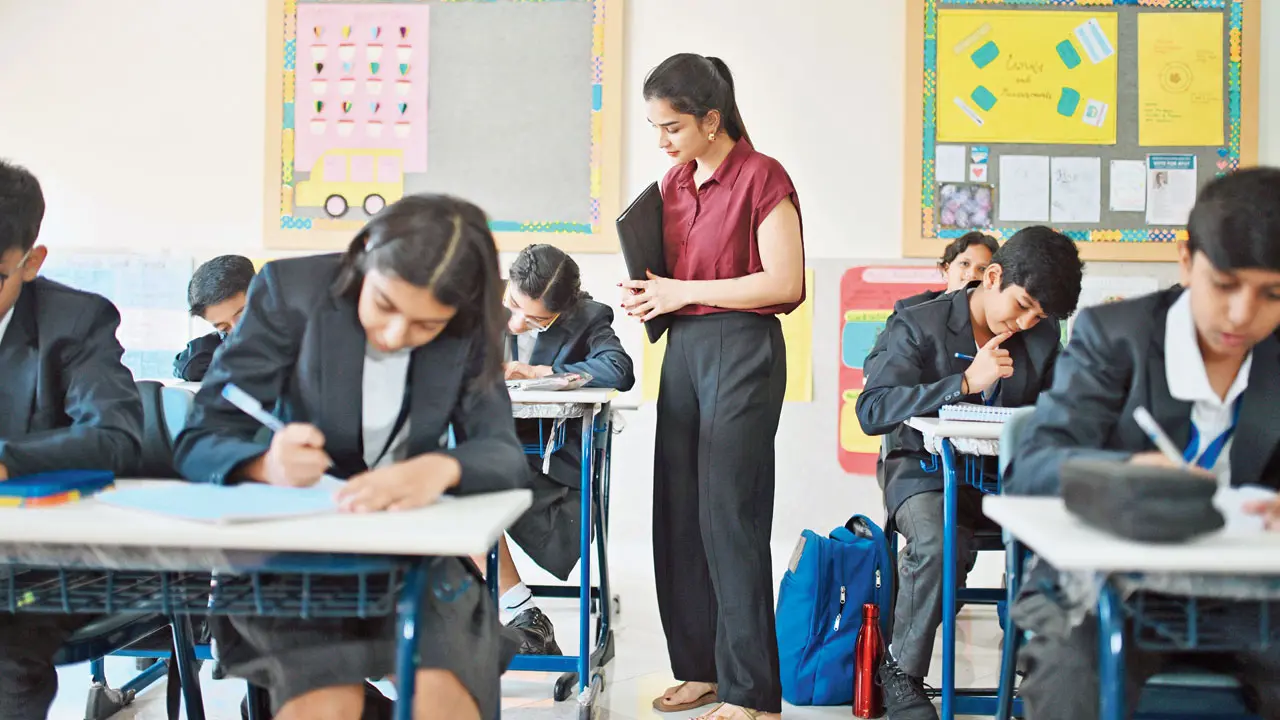
Students of various international boards point out a lack of Asian and Indian context. Pic/iStock
What happens when a high-schooler in Mumbai spends more time studying British or American history in class rather than what happened in India? Sure, this sets them up to be a “citizen of the world”, but are they truly ready to be a citizen of their own country?
This was not a major concern in past decades, when international schools were an option for an elite few: a diplomat’s child, or a political scion, or heirs to business empires. That is no longer the case; India now has the second-highest number of international schools in the world (972) according to education think tank, ISC Research.
The two most popular international boards that operate in India, International Baccalaureate (IB) and Cambridge Assessment International Education (CAIE, which runs the IGCSE format), were introduced in the 1970s and 1990s, respectively. But they truly took off in the early 2000s, when the idea of going abroad for higher studies became an aspiration for the middle classes as well. In fact, recently the Ministry of External Affairs said that between 2024-25, between 7.6 lakh students were pursuing further education abroad, mostly in Canada, the US, and the UK.
Therefore it’s no surprise that according to IB’s website (www.ibo.org), a total of 256 schools provide schooling under them. While CAIE said in a LinkedIn post last year that there are over 400 schools under their board that cater to around 17,000 learners. And, Maharashtra is leading the charge, with 210 IB and IGCSE schools.
These schools are praised for their inquiry-led approach, rather than learning by rote. However, a major gap that has begun to emerge in recent years is the lack of local cultural and historical context in these schools.
No doubt, many students will go on to study further abroad, some will also go on to work and live there. But are these schools merely preparing students for a future brain drain? What of the rest who choose to make their lives in their home country; do they possess enough knowledge to be go on to vote and perhaps decide India’s future?
A 15-year-old student tells us that she had no idea who was even contesting from their ward in the recent BMC elections. “I wouldn’t be able to tell you who was in the fray, who the popular candidate was, and who was unpopular. Sometimes I wonder, what else am I missing out on?”
972
Total no. of international schools in India
*ISC Research report, 2025
256
Total number of IB World schools in India that currently offer four International Baccalaureate (IB) programmes
400
No. of schools in India that follow Cambridge/IGCSE format
*IB, CAIE
Where’s the Indian context?
A 15-year-old who just appeared for her IGCSE exams says, “In IGCSE history, you have two options — the 19th century or the 20th century. Most schools offer the second option.”
“What I like about the Board is that it’s meant to be inclusive. Students can draw their own judgment on historical incidents, and no one will tell you that you cannot have a particular take. But all of the issues and questions that we study are Eurocentric. For example, the main topics that we have studied for years has been the time between World War I and the years between World War II and the entirety of Cold War — the Treaty of Versailles, the League of Nations, and control over Europe. There’s no consideration of Asian or Indian issues.”
This bright student cites an example of why this matters: “Our textbooks present [Nobel laureate and former US President] Woodrow Wilson as a good, idealistic man, because he stood against imperialism in Eastern Europe and wanted self-determination there. But there is no mention of imperialism happening all across Asia at the time. Suddenly, imperialism by the British Empire in their colonies wasn’t a problem.”
They lament that the format has not lived up to its full potential, especially for a system that has been functional in India for at least the last two decades. “If they could just expand the syllabus to include Indian and Asian issues, it would be incredible, because the methodology of learning actually encourages free thought,” they say.
“Ironically, though the curriculum encourages critical thinking,” says the teen, it puts the burden of learning essential local context entirely on the student. “You often have to go that extra mile to understand an incident from all angles. Or the alternative angle is mentioned in passing in our books, which is not enough for us to understand why this might not be the whole picture,” they add.
It’s the same with Latin America, they say. “The only time Latin America was introduced to us in the syllabus was in the context of Cold War tensions. They brought in Cuba only in the context of the US and the USSR.”
The cost of not knowing our own culture
“Although the international boards are built on the ethos of inquiring minds, I think there is a gap; many schools at their level are not able to address this lack of Indian history knowledge. This also comes with the fact that most teachers are not trained in the methods of these boards, primarily exhaustive documentation of class, and curation of anecdotes in the class. So, we are in dire need to upskill our teachers.”
Suraj Pandit and Swati Popat Vats
China takes a different approach
The only country with more international schools than India is China, with 1124 institutes. However, China’s Patriotic Education Law of 2024 stipulates that in all schools, curricula should reflect Chinese history and culture, language, ideology and politics.
International boards in india
. International Baccalaureate (IB)
. Cambridge Assessment International Education (CAIE)
. French Baccalaureate (FB)
. Canadian Board
Not all students interested in local context
Mahesh Srivastava
Mahesh Srivastava, who was the regional director (South Asia) for CAIE between 2020 and 2024, points out that adapting the curriculum across multiple countries becomes a challenge because each country’s perspective will be different. “History is very sensitive and specific to that country or geography, and perspective may change while you cross the boundary like in the recent Iran-US conflict, where both claim they are winning. To have Indian history as a subject, you need enough students to launch that course. But that doesn’t mean students can’t learn the subject; Individual Online School (IOS) gives you that option along with Cambridge Board,” he adds.
IGCSE also gives the option to study Marathi, Hindi, and Kannada, among other languages.
Subscribe today by clicking the link and stay updated with the latest news!" Click here!