Home / Sunday-mid-day / Article /
Farah and the beanstalk
Updated On: 25 October, 2020 07:44 AM IST | Mumbai | Prutha Bhosle
A filmmaker with an interest in edible greens runs a quaint documentation project that you should check out to understand what you put in your mouth





The sat patta dal is prepared with the addition of greens. It is cooked only with mash and moong dals
Trained as a filmmaker, 32-year-old Farah Yameen's work now primarily surrounds public histories, digital archives, and food ethnographies. But, it is her knowledge in edible greens that she is recently becoming known for. "My interest in edible greens was not an epiphanous eureka moment. I was not an adventurous greens eater as child. In fact, I think I can safely say that we rotated between some 20 vegetables in our household, many of which I'd screw my face at. This, even though I grew up in Jharkhand, a place of many indigenous cuisines, and more greens than I can name. I had never eaten sarson [mustard] or goosefoot [bathua] until I came to Delhi to study at Jamia Millia Islamia," she admits. And that's surprising because she is now the name behind the fascinating Instagram project, The Saag Archive.
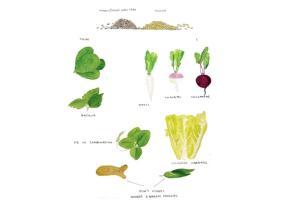
When it launched, the page featured Yameen's drawings on new greens that she spotted in vegetable markets. "It dawned upon me belatedly [and if you think about it, this was obvious] that the way we eat greens, and the kinds we eat, reflect multiple things: agrobiodiversity, climate change, social inequality, the market economy and local food cultures. The biodiversity and climate change aspect is evident enough. A number of species and wild foods are threatened on account of monocultures and climate change. Most of us cannot recognise one weed from another, although there are new foraging movements that are attempting to change this. But while it is easy to exoticise this as traditional knowledge being preserved—which I admit is certainly an aspect—an equally important perspective is that a number of greens are eaten because no food is available. Khesari for instance, is a weed that was later cultivated for both its legumes and leaves in case drought struck. Many leaves became part of our food because people could not afford other sources of sustenance. It is also why most leaves are cooked so simply—boiled or lightly fried in fat—there were limited resources."
Trending Stories
Latest Photos
Latest Videos
Latest Web Stories
ADVERTISEMENT

Ganeshotsav 2026

ADVERTISEMENT