Home / Sunday-mid-day / Article /
How Arthur Conan Doyle saved a Parsi lawyer
Updated On: 14 March, 2021 08:55 AM IST | Mumbai | Fiona Fernandez
Why did Sherlock Holmes’ creator support convicted son of Britain’s first ever South Asian vicar? Shrabani Basu’s new title unravels how race, class and sociological dynamics played out in one of the Empire’s most sensational cases of the early 20th century





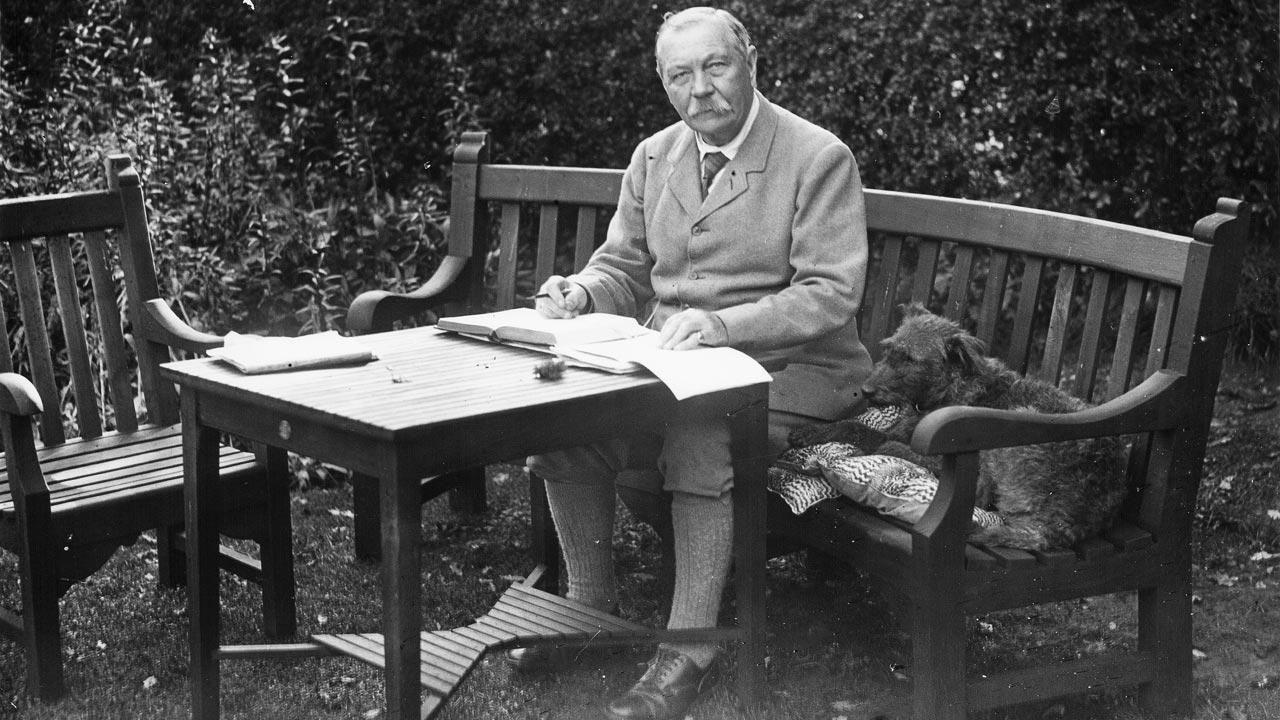
Portrait of Sir Arthur Conan Doyle sitting at a table in his garden, Bignell Wood, New Forest, in 1927. Pic/Getty Images
There is a section in The Mystery of The Parsee Lawyer: Arthur Conan Doyle, George Edalji and the case of the foreigner in the English village (Bloomsbury), where the first meeting between Sir Arthur Conan Doyle and Staffordshire’s police chief Captain GA Anson is explained in detail. It proves to be an eye opener for the intuitive author who has decided to back a studious Parsi lawyer who reaches out to him for help, having lost faith in the police and legal system, after completing a jail term. Their exchange reveals to Doyle the coloured mindset of authorities judging every Oriental, irrespective of upbringing, education and profession. Doyle takes up the investigation, and thus, a friendship develops between George Edalji, the ‘half-caste son’ of an Indian clergyman and his unlikely saviour, the highly respected creator of the Sherlock Holmes series.
Shrabani Basu’s new book is the result of meticulous detail. The author says she travelled to the small parish village in Great Wyrley to retrace the nearly century-old saga, from the time the patriarch, Shapurji arrived in Britain in 1866 as a Parsi convert to Christianity; his elevation as the first South Asian vicar of an English parish; to when the needle of suspicion was cast over the Edaljis’ happy existence, first with mysterious letters and later, with gruesome murders of cattle and horses; how the case blew out of proportion with the imprisonment of the eldest son, George and its fadeout with the demise of Shapurji’s daughter, Maud in 1961.
Shapurji’s early life in Bombay is equally insightful: his days as an impressionable Elphinstonian who decided to follow the path of missionaries, and his rebellion and estrangement from his shocked Zoroastrian parents in 1800s Bombay as they faced their son’s decision to convert. The fighting spirit in young Shapurji was replayed years later, when he backed his wronged son despite societal pressure and a biased judiciary. He carried on with his pastoral duties, and backed George without moving out of his parish.
Trending Stories
Latest Photos
Latest Videos
Latest Web Stories
ADVERTISEMENT

Ganeshotsav 2026

ADVERTISEMENT