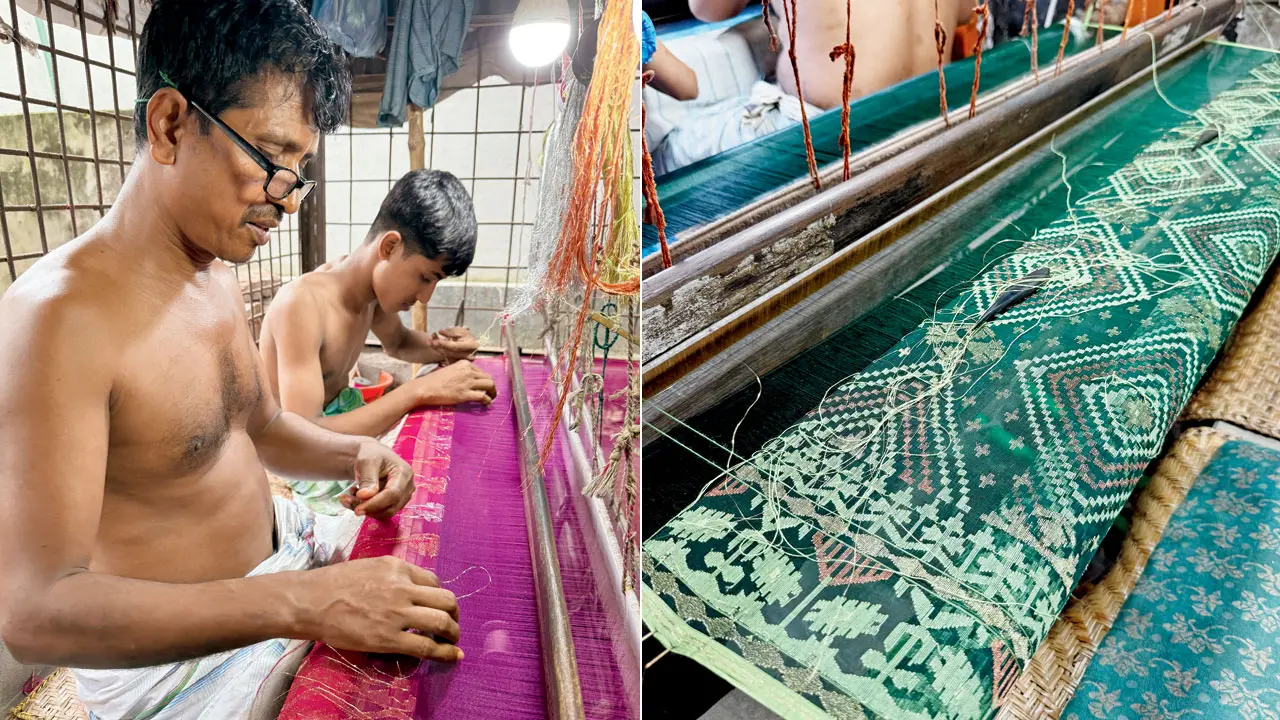
We thread together how recent Indo-Bangla tensions and trade disruptions have impacted the Jamdani industry

It can take Bangladeshi artisans about 15 to 20 days to weave a single Jamdani saree because of the intricate motifs. Pics Courtesy/Anisuzzaman Khan
Barun Das (name changed) has been going to Kolkata from his home in Bangladesh’s Narayanganj District, a major textile hub in the country, with Jamdani and muslin saris and kurtas since the time of Buddhadeb Bhattacharjee’s chief ministership in the 2000s.
A Jamdani boutique in Dhaka. Jamdani trade has also been impacted by growing anti-India sentiments in Bangladesh due to political differences, as well as clashes over whom the Jamdani heritage actually belongs to. Pic/Getty Images
Having joined his family’s Jamdani trade during his school days, Das recalls attending several exhibitions at the Academy of Fine Arts, the Calcutta Ice Skating Rink, the Bangladesh Deputy High Commission in Kolkata, and annual trade fairs, which would yield satisfactory sales. He would also supply to boutiques and individual clients through references. Given the Jamdani’s popularity and the demand for the more prized Bangladeshi variety, his business had expanded to other metro cities in India as well.
Krishna Gopal Choudhury, Bipul Chattopadhyay and Saiful Islam
“The last two years [since late 2023] have been more disastrous for us than the pandemic,” Das tells Sunday mid-day. “We were unable to obtain visas and couldn’t participate in any of the exhibitions in Kolkata and lost out on a lot of business as a result. Travelling between the two countries has become difficult,” he says, alluding, besides weavers, to the frequent Bangladeshi medical tourists to India.

In an industry that relies heavily on an informal trust-based credit system, during this period of political volatility and confusion, many clients defaulted on payments. “Business has been bad,” says Das, even as he insists on the generosity of many of his Kolkata customers, “who have helped us out during these trying circumstances.” Due to economic strains, interest from individual buyers for a premium luxury item has also fallen, he says, which, in turn, has affected production. “If we were making 120 saris in a day earlier, now we are making 30.”
Zakir Mollah, a weaver who lives and works in Murapara in Narayanganj, Bangladesh, has worked in the family Jamdani business for 30 years. He says that in the last few years since many cotton mills in Bangladesh have shut down, they have had to rely on India and China for cotton
Rs 3500
Average cost of simpler Jamdani sarees
Rs 1Lakh
Average cost of a complex Dhakai Jamdani saree
Trivia
Indo-Bangla trade relations have declined by more than 30 per cent in the last 2 years, say experts
Whose weave is it anyway?
India and Bangladesh have for long clashed over the authenticity, regional origin, and commercial rights of the Jamdani. The reasons for this are both bureaucratic and technical.
Both countries have geographical indication (GI) registration for Jamdani. In India, each state has a budget to compete for GI tags, making it more agile when it came to claiming the Jamdani as its own, says Saiful Islam, founder and MD of the Bengal Muslin project. “In Bangladesh,” he adds, “the system is slower and more bureaucratic.”
“There is this feeling in India that they were the larger country with the other subcontinental countries being part of the greater India, where their heritage extends back rather than going forward. That is a source of confusion and confrontation,” says Islam.
Moreover, confusion around what constitutes a Jamdani has further muddled the issue. The definition of Jamdani sits within its patterns and its weave, explains Islam. In Bangladesh, it’s the unique motifs made by the extra weft that define a Jamdani, while in West Bengal, it’s not those designs, but simply the extra weft. “This should not be allowed to happen, but is happening,” he says. This weaponisation of cultural heritage for political and economic reasons is not necessarily the result of recent tensions but a longer term issue, says Islam. “But with the recent unrest, the chances of reaching amicable solutions are going to be even less.”
The industry for years has been plagued by problems faced by the handloom industry as a whole, such as industrialisation, lack of recognition, low reward structures, and cheaper alternatives. As Islam says, “It might be a hereditary business, but it is no longer a hereditary profession.”
There are also Bangladesh-specific factors like high logistical costs due to pressure on roads, as Bipul Chattopadhyay, executive director at CUTS International — a Rajasthan-based non-profit that works to promote consumer empowerment — points out. There is also a lack of diversification that has affected traditional Jamdani weaving families, forcing many to leave a generational trade. Chattopadhyay offers the example of Rajasthan’s kota doria fabric, where not just saris but dress material is also made in bulk. “That diversification is happening much faster in India as compared to Bangladesh.”
Political undercurrents
The economic, craft and trade relationships between the two countries have played out against the larger political background of India’s unpopular backing of former Bangladeshi PM Sheikh Hasina and her Awami League Party and the deep anti-India sentiments that surfaced during the Gen Z-led July 2024 uprising. “There is a strong feeling within Bangladesh that India has forever treated it as a second-rate partner,” shares Islam. “[In the last two years], the trade relationship has gone down by more than 30 per cent.”
The Jamdani trade, Islam further explains, has formal and informal prongs, with the informal one believed to be at least four times that of the formal one. This informal trade, he believes, has continued to some extent despite the general supply chain disruptions. Although the numbers have declined by 60-70 per cent, there are still people willing to take items across the border.
Moreover, with all manner of Bangladeshi tourists to India declining, there is more money available for those tourists to shop locally in Bangladesh, shares Islam. “More Bangladeshi women are buying Jamdani, and are paying more attention to local products in lieu of shopping in Kolkata.”
In the midst of straining Indo-Bangla ties, the Jamdani has revived longstanding conversations between the two countries around cultural identity. In December 2024 for instance, demonstrators burned Dhakai Jamdani sarees at a rally in Kolkata to protest against atrocities against Hindus in Bangladesh.
Carrying cash across the border
Krishna Gopal Choudhury runs a virtual store, Dhakar Anka, as well as an ancillary studio in Kolkata’s VIP Road that offers “a platter of crafts from the other side of Bengal”. A textile designing graduate from NIFT, Kolkata, Choudhury has visited regions of Bangladesh in search of handicrafts and the artisans who make them, travelling through Narayanganj and Shahzadpur for Jamdani, Jamalpur for nakshi kantha and nakshi pakha, Sylhet for nakshi pati, Tangail for the tangail sari, Kushtia for handwoven gamchas and lungis, and Kishoreganj for clay idols.
But working exclusively with artisans from across the border has had its challenges. There is no official transactional system between India and Bangladesh, says Choudhury. In the absence of a direct online system to enable payments, there are invariably problems to be faced when carrying cash across the border, he says.
What happened?
Sheikh Hasina
India-Bangladesh relations have been strained since the neighbouring country’s former PM Sheikh Hasina was ousted and took refuge in India, creating a diplomatic crisis. Current geopolitical unrest, coupled with visa hurdles between the two countries, has only exacerbated those difficulties.
On May 17, 2025, India banned the import of garments, processed foods, wooden furniture, and other items from Bangladesh across land borders, resulting in the time-consuming re-routing of trade to seaports. “Your craft item now has to go to Chottogram Port which is in a remote part of Bangladesh.
Transportation which earlier took a week, now takes a month or two,” says business owner Krishna Gopal Choudhury.
But the Jamdani has not been rerouted to seaports, insists UK-based textile revivalist and founder and Managing Director of the Bengal Muslin project, Saiful Islam. “Jamdani is still very much a land-based trade. It is not centralised, unlike the garments industry which is vast and powerful, and has found shipping alternatives through Maldives or Sri Lanka.”
“Jamdani has individual traders — some big, some small. It is a land route-based industry with no sea alternatives. It’s a question of taking more risks.”
In April 2025, Bangladesh too had restricted certain imports from India, including cotton yarn — part of a ‘mini-trade war ‘after India suspended transhipment facilities.
Subscribe today by clicking the link and stay updated with the latest news!" Click here!