Home / Sunday-mid-day / Article /
Mumbai Coronavirus: Making sense of COVID-19 numbers
Updated On: 19 July, 2020 07:21 AM IST | Mumbai | Jane Borges, Prutha Bhosle
While the government and health officials might claim that India is flattening its curve, meet the experts looking into hard numbers and data predict a reality that is a lot grimmer





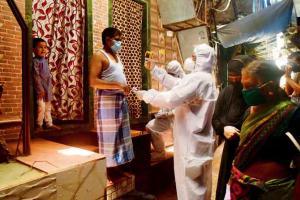
James Wilson says that the densely-populated slum pocket of Dharavi beat the virus, because of the extensive testing policy adopted by the BMC and the work of contact tracers. Pics/ Suresh Karkera and Bipin Kokate
BAD news is never welcome. Especially not when there is a glut of it already. For a world struggling to cope with everything from climate change to the Coronavirus pandemic, addressing the elephant in the room feels like a sinister attempt to snatch away the little stories we have for comfort. And yet, that's what drives us. In his new book, Bad News, American academic psychologist Robert Brotherton points out that bad news thrives, because "press corps have actively encouraged cynicism". "That necessarily entails seeking out wrongdoing, misconduct, failure, corruption, greed, cruelty, injustice, villains, and victims. In this light, being the bearer of bad news isn't a vice, but a virtue. It means you're doing your job right," he writes.
It's this cynicism coupled with curiosity that has led Trivandrum-based civil engineer and data analyst James Wilson to engage with COVID-19 data from across the world. Wilson says he has no agenda. He simply wants to understand the reality of where India stands in the fight against the virus. All through March and April, when the health infrastructure in Spain and Italy was crumbling, and India was being lauded for keeping COVID-19 cases under check, Wilson was advocating "testing and more testing" on his Twitter feed ( @jamewils). He even described the Indian Council for Medical Research's (ICMR) criteria of testing only symptomatic patients as "limited and rigid," and called it out for following the "don't test, don't find" approach. Four months on, having increased its testing capacity manifold, India is finally coming face to face with reality. With 10 lakh confirmed COVID-19 cases, it is now the third most-affected country in the world.
Trending Stories
Latest Photos
Latest Videos
Latest Web Stories
ADVERTISEMENT

Ganeshotsav 2026

ADVERTISEMENT