Home / Sunday-mid-day / Article /
New books offers rare insight on how magicians became international phenomenon
Updated On: 08 July, 2018 08:02 AM IST | Mumbai | Jane Borges
It's curiosity that eventually compelled John Zubrzycki to invest two years of research on his new book, trawling through archives in New Delhi, Mumbai an Kolkata, as well as in London, New York and Washington.





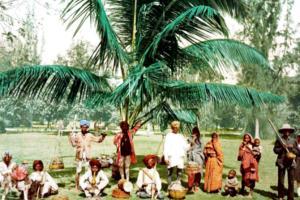
A troupe of jugglers in the gardens of Bombay University, circa 1920. Pic Courtesy/Library of Congress
Author John Zubrzycki's new non-fiction, Jadoowallahs, Jugglers and Jinns: A Magical History of India (Picador India, Pan Macmillan), opens at a very significant point in the country's tryst with the art. We are told about Mughal emperor Jahangir, who presided over the empire at the height of its power, and of his strange obsession with necromancy and magic. "...it interfered with the day-to-day running of the court to such an extent that a group of complainants wishing to report abuses of power by the Governor of Bengal, had to dress up as magicians to get his attention," writes the Sydney-based writer, who has a degree in South Asian history and Hindi from the Australian National University.
But, the overwhelming response to the conjuring arts, wasn't just an experience limited to the Mughal leader. "No one who travels in India and encounters its street magicians can fail to be impressed by them," insists Zubrzycki, whose first stumble upon Indian magic in December 1979, when he witnessed the unusual basket trick. "What Western conjurers can accomplish on a stage with sophisticated props, the humble jadoowallah can do out in the open, surrounded on all sides by a crowd of onlookers. The version of the basket trick I saw ended with the magician's assistant, a young boy, being held up with a knife through his throat. I'm still convinced there was no trickery involved," he says, in an email interview.
Trending Stories
Latest Photos
Latest Videos
Latest Web Stories
ADVERTISEMENT

Ganeshotsav 2026

ADVERTISEMENT