shot-button
Home > Sunday Mid Day News > Opening doors with kindness

Opening doors with kindness

Updated on: 29 March,2026 08:55 AM IST  |  Mumbai
Team SMD |

Parenting a child with autism can seem daunting, but in her new book, Sangeetha Chakrapani, founder of Andheri’s Together Foundation, shows how a ‘whatever it takes’ attitude can bring hope flooding back in

Opening doors with kindness

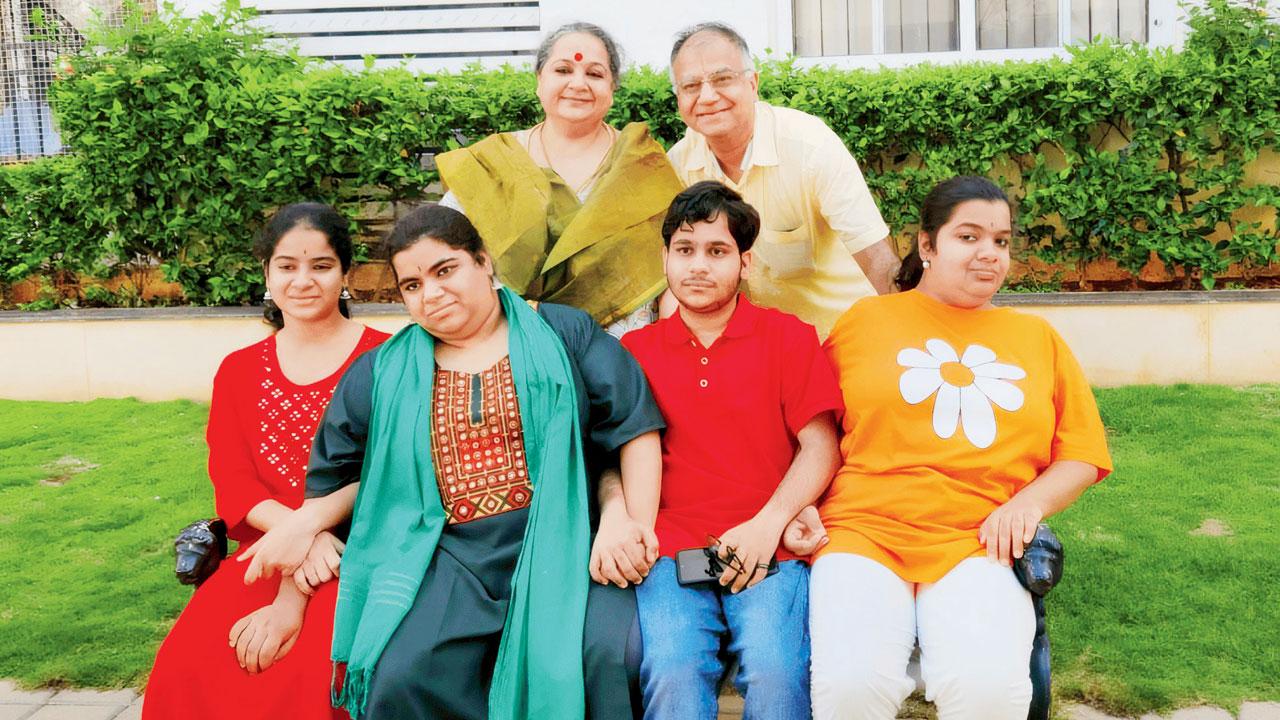
Sangeetha Chakrapani with her husband, CP, and children — Jayashree, Lakshmi, Krishna, and Jayanthi. Pic Courtesy/Sangeetha Chakrapani

Listen to this article
Opening doors with kindness
x
00:00

I remember the day [author’s daughter] Jayanthi was diagnosed with autism. Just two years old, she sat next to me in the car. We were on our way to Ummeed Child Development Centre. My heart was thumping. I could barely focus when the driver asked me where we were to go. I just wanted to get to Ummeed and convince them that the strange sounds that Jayanthi made, the way she lifted her hands to her face to stare at her fingers, her complete focus on herself, her lack of response to her name, were not of any significance.

I felt a wave of embarrassment as the driver turned to look at Jayanthi due to the sounds she was making, and I tried to get her to stop.


This was my first step into autism parenting. The beginning is traumatic, socially debilitating and takes a toll on every relationship. The parent cringes when his child is the painfully odd one out at a party. When the parent can’t make a simple introduction to his friends, “This is my son, Gaurav”, because he knows Gaurav will be looking on blankly. At a family wedding, his child is the only one who does not mingle with his cousins. He uses the bathroom with the door open even at other people’s homes. Every awkward behaviour, every strange sound, every anomaly grates on the feelings of a new autism parent.


The embarrassment is acute, the hurt deep, and the smile plastic. Parties are endured rather than enjoyed as the parent deals with a child who, through his behaviour, announces to the world: I am not the same as you.

With the passage of time, the parent’s hurt is washed away by the child’s innocence. Her despondence is converted to courage when she sees her child slowly learning. Rays of hope fill her heart as she sees her child draw or paint or dance or sing.

A new resolve strengthens her shoulders as she starts reading about autism, attending workshops and learning ways to decode her child.

The same parent calmly tells Jayanthi as she hums loudly in an elevator full of people, “Jayanthi, quiet time.”

She stands outside the washroom in a mall with no discomfort at all and clearly instructs Jayanthi, “Please lock the door. Do you need help?”

She smilingly approaches her host at a party. “Jayanthi and I will sit in that quiet corner. Is that okay?”

The same parent firmly tells Gaurav as he decides to masturbate in a mall, “Gaurav, please go to the bathroom, not here”, and waits for him to stop and escorts him to the bathroom.

She uses all her understanding and reflexes when Gaurav starts weeping at a family wedding and wants to go home that very moment. She calmly apologises and leaves with her son.

She goes home, helps her child unwind, makes herself a drink of cocoa or Thums Up or wine before hitting the bed. Yet again, before her head touches the pillow, she makes her way to her sleeping child who is no longer a child. Looks at his wan face, puts her hand over his locks of hair, presses her lips to his forehead, sheds quiet tears for their shared journey that is sometimes full of hope and sometimes undetermined, sometimes charged with achievement and sometimes confused and irresolute.

Another day begins the next morning. She picks up her phone and starts typing on her parent WhatsApp group, “I had a problem with Rahul at a party last night.” She sends an email to her child’s therapist, “Rahul needs help.” She calls up Forum for Autism, “I am an autism parent. Can I get a counsellor? I need to talk.”

Excerpted with permission from Whatever It Takes: Autism, Parenting and A Dream by Sangeetha Chakrapani, Westland Books

April 2
Is observed as World Autism Awareness Day

Do you remember that moment in school when you could not give the right answer immediately? Before you could try one more time, the teacher patted you kindly on the shoulder. “Never mind, next time, okay?”

The frustration! I needed only one minute longer!
This is what happens frequently to many people with autism and their families.
A family is out with their son, Rohit, who has autism. They meet a good friend.
“Wow! What a surprise to see all of you here!”
A big round of hellos follows.
Mom: “Rohit, look who’s here! Sheena!”
Sheena: “Hi, Rohit.”
Mom: “Rohit, say hello to Sheena.”
Sheena: “Hi, Rohit, hi!”
Dad: “Rohit, Sheena is saying hi to you.”
Sheena: “It’s okay!”
Sheena pats Rohit on head or shoulder or some other available body part.
A big round of byes follows.
In this melee of conversation, Rohit did not get a chance to say hello and Sheena did not get a chance to connect with Rohit.

Situation 2
“Wow! Imagine meeting you here!”
“Hello! Hi! How are you doing?”
Sheena: “Hello, Rohit!”
Pause.
Mom: “Rohit, let’s say hi to Sheena.”
Sheena: “I also like talking with you, Rohit!”
Pause.
Pause.
Pause.
Pause for a few precious seconds.
The sweetest of smiles breaks out on Rohit’s face, the equivalent of a hundred hellos.
Or, Rohit extends a hand tentatively.
Or, Rohit says a “hi” that is just about audible, but sounds like Mozart’s Symphony No. 40 in G Minor K. 550 to the mother.
Or, Rohit looks deep into the Milky Way, but says a loud “hi”.
Or, Rohit looks straight into Sheena’s eyes and says a crisp “hi”.
Or, Rohit just glances at Sheena — one more way of saying “hi”.

This simple exchange of greetings is so important for people with autism. To be given the time and the opportunity to:
1. Process that somebody known to them has suddenly come up.
2. Process the identity of that person.
3. Process the greeting that person is making.
4. Process the suggestion made by the mother.
5. Convert the suggestion into an action.

It is not kind to shush a person with autism when he is trying to say or signal something.
It is not kind to pat him on the head and move away.
It is not kind to expect him to respond instantaneously.
It is not kind to bombard him with multiple instructions such as “Say hi”, “Come on”, “Quickly say hi”, “Chalo, hi bol do”.
Being kind is when you make an effort to look into Rohit’s eyes, greet him and give him a few seconds of quiet time to acknowledge you.
Be that person in Rohit’s life who opens gateways of communication with him by gifting him a few seconds of your time and your acceptance.

"Exciting news! Mid-day is now on WhatsApp Channels Subscribe today by clicking the link and stay updated with the latest news!" Click here!

Did you find this article helpful?

Yes
No

Help us improve further by providing more detailed feedback and stand a chance to win a 3-month e-paper subscription! Click Here

Note: Winners will be selected via a lucky draw.

Help us improve further by providing more detailed feedback and stand a chance to win a 3-month e-paper subscription! Click Here

Note: Winners will be selected via a lucky draw.

Autism health Health And Wellness Lifestyle news parenting

Mid-Day Web Stories

Mid-Day Web Stories

This website uses cookie or similar technologies, to enhance your browsing experience and provide personalised recommendations. By continuing to use our website, you agree to our Privacy Policy and Cookie Policy. OK