Home / Sunday-mid-day / Article /
Tackling this virus will be messy and politically fractious
Updated On: 19 April, 2020 07:02 AM IST | Mumbai | Jane Borges
Noted American science journalist Sonia Shah believes the enemy in the war against pandemics isn't another country, but industrial expansion at the cost of climate abuse





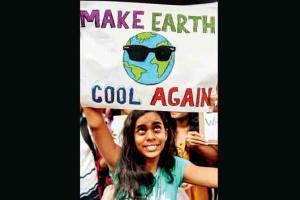
A file photo of a student holding a poster at Fridays for Future climate strike in Mumbai to protest against governments' inaction towards climate breakdown and environmental pollution. Pic/ Getty Images
Every disease begins as an alien concept, before it starts becoming familiar. Coronavirus is no different. But the scale and speed at which the infection has spread, is unsettling and leaves no room for familiarity. American science journalist Sonia Shah, who has been invested in the study of infectious diseases, says, "Pathogens have had a tremendous and under-reported influence on human history, as we're seeing this unfold before our eyes right now." Shah is the author of The Fever (2010), a book where she tracked the history and spread of malaria, and the 2017 title Pandemic: Tracking Contagions from Cholera to Ebola and Beyond.
She started writing about health and infectious diseases "as a way to understand the origins of inequalities"—those that existed between men and women, between rich and poor, between the healthy and the sick, both within and between societies. "Having malaria in your society, for example, reduces GDP growth. And it has shaped our history, our bodies, our settlement patterns for millennia," she says in an email interview from Baltimore. It might be too soon to say how the Coronavirus will change us. But Shah, who is set to release her new book, The Next Great Migration: The Beauty and Terror of Life on the Move, feels that governments "will have to juggle between losing lives and livelihoods" before this one passes.
Trending Stories
Latest Photos
Latest Videos
Latest Web Stories
ADVERTISEMENT

Ganeshotsav 2026

ADVERTISEMENT