Home / Sunday-mid-day / Article /
The agony of displacement
Updated On: 25 January, 2015 02:36 AM IST | | Phorum Dalal
Artist Ranbir Kaleka’s installation, House of Opaque, which reflects the loss caused by the recurring Sundarbans flood, is one of the top 15 works selected for the Asia Pacific Brewery Foundation’s Signature Art Prize





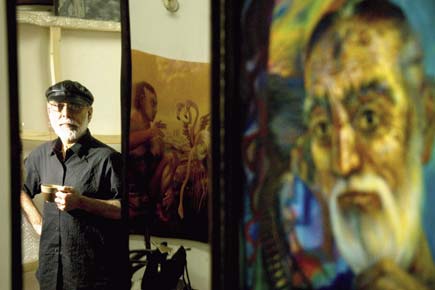
The art installation titled House of Opaque by New Delhi-based artist Ranbir Kaleka is one of the top 15 works selected out of 105 entries from 24 countries for the Asia Pacific Brewery Foundation’s Signature Art Prize to be announced this week. The award recognises outstanding contemporary visual artwork produced in the region. The 61-year-old artist created the 12-metre-wide installation for the Kochi Biennale 2012. It uses a narrative structure to present the idea of displacement and society’s response to it. A quick chat with Kaleka:

A still from the installation, House of Opaque, (below) multimedia artist Ranbir Kaleka. Pic courtesy: Adam Huggins
Q. Can you tell us a bit about House of Opaque?
A. House of Opaque is inspired by a documentary titled Mean Sea Level (2009) shot by a friend and filmmaker, Pradip Saha. The story is set in the Sundarbans in West Bengal, in which a villager is shown pointing to his house, houses of his friends and a tree he played under, in his childhood. But when the camera zooms out, you find him standing in a boat and all around him is marshland. The floods and massive erosion due to climate change have destroyed his village. The video installation first plays factual shots, and slowly turns it into an artwork. The idea was to map the villager’s internal turmoil. His house, which is now underwater is half eroded, on the bed of the sea. He makes a sand sculpture of his house on the sea shore, but the rising tide swallows it. As an artist, my idea was to delve into his mind.
Trending Stories
Latest Photos
Latest Videos
Latest Web Stories
ADVERTISEMENT

Ganeshotsav 2026

ADVERTISEMENT