Home / Sunday-mid-day / Article /
The Bombay that didn’t get built
Updated On: 23 January, 2022 07:52 AM IST | Mumbai | Jane Borges
An American architect for whom Mumbai is home dips into old archives and studios over seven years to tell the story of an audaciously imagined city before it became a thriving megalopolis





After hearing about William Sowerby’s drainage plan of 1868 for the overflowing metropolis, Executive Engineer Hector Tulloch is said to have “held up his hands in horror at the idea of a canal passing through the heart of Bombay”
When Gerald Aungier took over as governor of Bombay in 1669, a mammoth task awaited him. A message from his bosses in Britain relayed a simple instruction: Build a new city here (and soon). A map of London was also sent to fuel his inspiration. Aungier, however, had resisted the idea. Though aware of the inevitability of his role in transforming this land of marshes and disease into one of Britain’s richest commercial hub, he had written back saying that the “timing wasn’t right”. “In order to build such a city, he’d have to first cut down hundreds of palms, but the local populace was deeply attached to their trees. He conveyed to the authorities that if he acted immediately, there could be riots and unrest. Instead, he focused on strengthening the Bombay castle,” says Robert Stephens, principal, RMA Architects and founder of Urbs Indis, a studio that narrates lesser-known civic histories through juxtaposition of archival material with contemporary aerial photographs of urban India. That’s how “Bombay” became the first unrealised project in the city’s history, Stephens tells us over a video call.
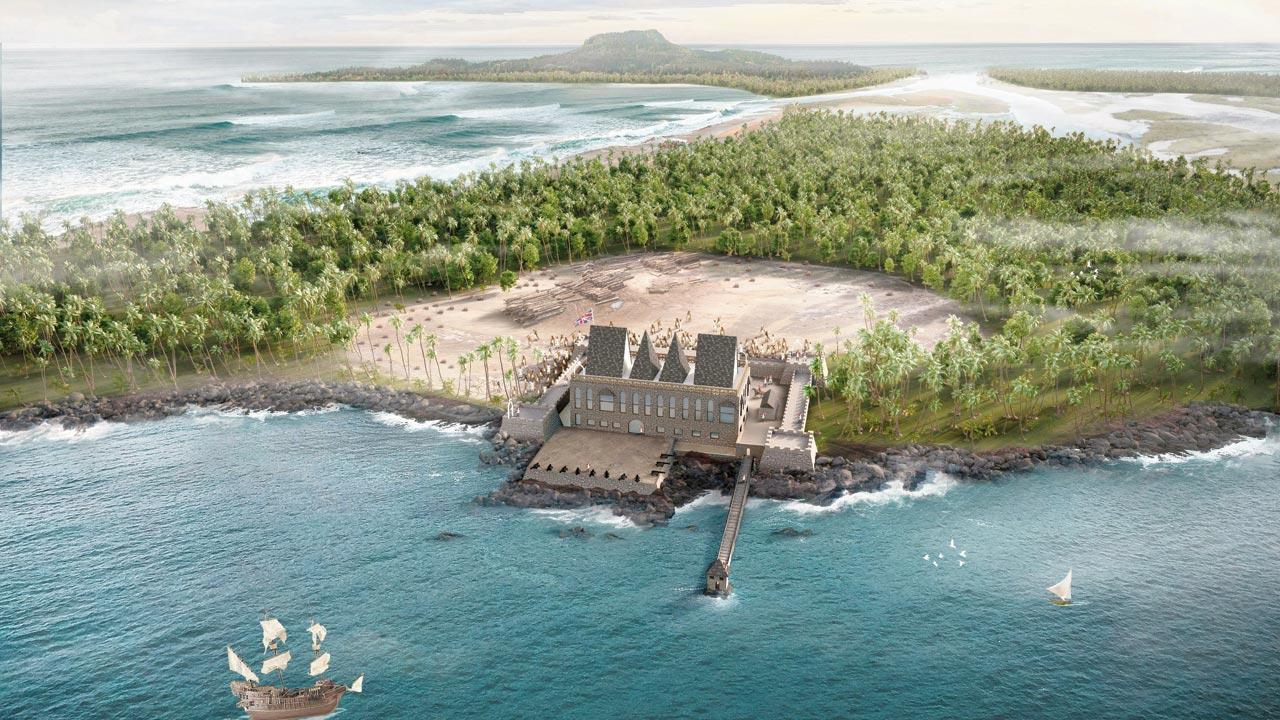
The architect has re-envisioned this particular project in a soon-to-release self-published coffee table title, Bombay Imagined: An Illustrated History of the Unbuilt City. Armed with just this tiny piece of information available in official records, Stephens speculates how the Fort precinct would have looked had Aungier acted on the instruction right then. In the artwork that finds its way into the book, the Bombay Castle—modelled on archival drawings that he had access to—stands on the fringes of the island surrounded by a grove of palms, facing the vast blue Arabian Sea. Far ahead is a green hillock—what we today know as Malabar Hill—with the salt flats to the right. The image shows a precinct that has been completely eroded of its palm trees, enough to incite locals, who’ve gheraoed the castle’s walls. None of this happened for real of course, but Stephens’ work explores the “what ifs” rather than the “what was”.
Trending Stories
Latest Photos
Latest Videos
Latest Web Stories
ADVERTISEMENT

Ganeshotsav 2026

ADVERTISEMENT