Home / Sunday-mid-day / Article /
The last 31
Updated On: 16 February, 2020 07:27 AM IST | Mumbai | Dalreen Ramos
Sunday mid-day goes on a walk across the old parts of the city with two history students who have brought attention to Mumbai's last surviving gas lamps, now neglected, but once champions of safe Bombay





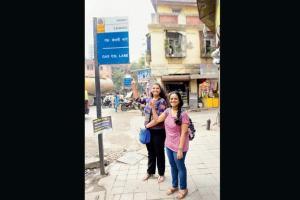
History students Riddhi Joshi and Yogini Aatreya at the entrance of Lalbaug's Gas Co. Lane where the Bombay Gas Co. was set up to power the city's streetlights. Pics/ Bipin Kokate
Indeed, it is almost impossible for those softened by the ease of life today to realise what it was before this servant was harnessed to the well-being of the citizens." In 1936, British politician and long-serving editor of a national daily, Sir Herbert Stanley Reed, regarded the advent of electricity i.e. the servant, as the most beneficial change he'd seen in Bombay since he landed in 1897. His early days here, as detailed in the foreword of Pestonji Mahaluxmiwala's History of the Bombay Electric Supply and Tramways, were marked by dinners under stinky oil lamps that made one sweat.
The idea of public lighting emerged when city governor John Fitzgibbon visited shipbuilder Ardeshir Cursetjee, who had a gas lamp installed at his Mazagaon home, and was amazed by what he saw. But the concept of street lighting didn't materialise until 1843 when kerosene lamps were installed. Then, two decades later, as Arthur Crawford became Bombay's first municipal commissioner, the city was illuminated with more efficient gas lamps—magnificently constructed out of cast iron and at a staggering 17 feet or higher.
Trending Stories
Latest Photos
Latest Videos
Latest Web Stories
ADVERTISEMENT
Mid-Day Fast
ADVERTISEMENT