Home / Sunday-mid-day / Article /
‘We won’t rest until Kashi is ours’: Is Ayodhya template being adopted to reclaim Gyanvapi
Updated On: 18 September, 2022 09:30 AM IST | Mumbai | Yusra Husain
With a Varanasi court clearing the decks for fresh trial this week, mosque management cries foul, even as petitioners tell mid-day they are gearing up for a ‘dharamyuddh’ and will ensure they take back all their temples



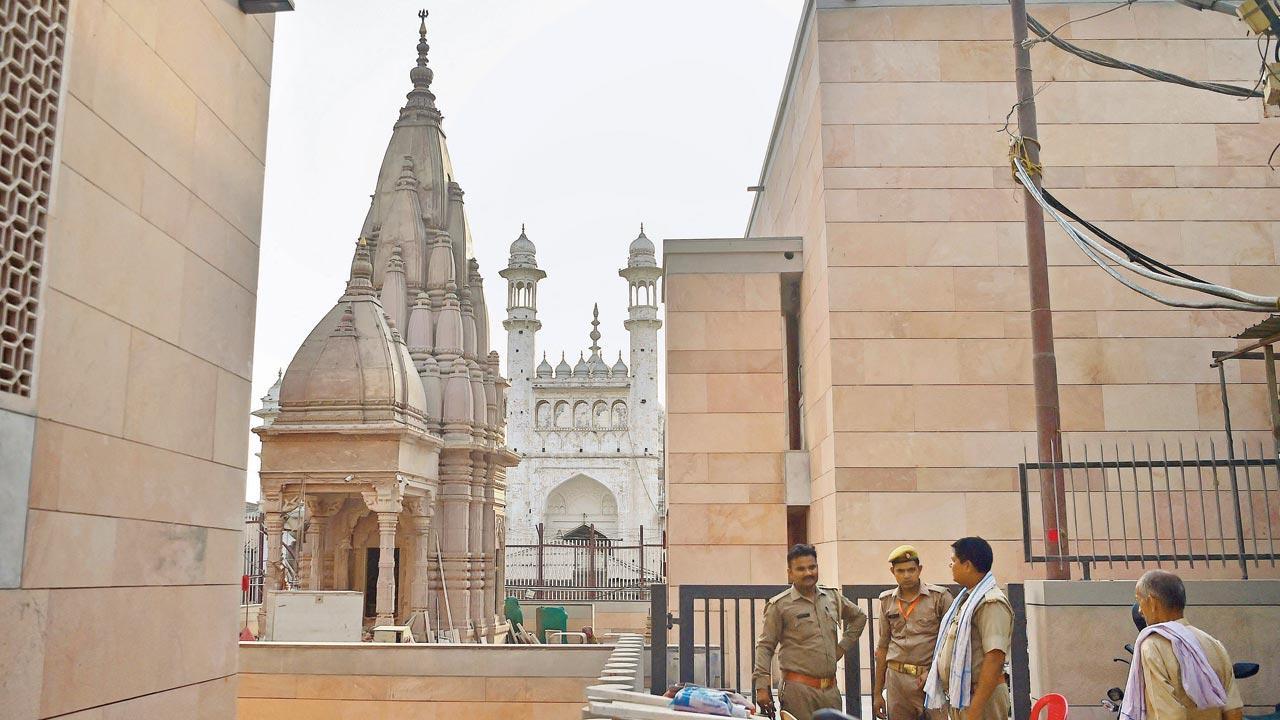
Policemen stand guard near the Gyanvapi mosque during Friday noon prayers in Varanasi. Earlier this week, the District and Sessions court of Varanasi held the civil suit filed by five female devotees seeking the right to pray to Maa Shringar Gauri and other visible and invisible deities, which they claim were being worshipped till 1993, was maintainable. Pic/Getty Images
Varanasi resident Sohan Lal Arya was in his 40s, when he performed karseva at Ayodhya on December 6, 1992 to demolish the Babri Masjid. Three decades on, the 72-year-old still flaunts a stone block from the “dhancha” (the mosque that was torn down) in his home. The souvenir, he says, reminds him of the path that lies ahead. “We will get back all our temples,” he says.
Arya is the divisional vice president of Vishwa Hindu Parishad (VHP) and a member of the Rashtriya Swayamsevak Sangh (RSS) in Varanasi. His wife, Laxmi Devi, is one of the five female petitioners in the suit that demanded the right to worship Goddess Shringar Gauri in the precincts of the Kashi Vishwanath temple-Gyanvapi mosque complex on a daily basis. Until now, the pooja and darshan of Maa Shringar Gauri took place only once a year during Chaitra Navaratra at the western wall behind the mosque. Earlier this week, the District and Sessions court of Varanasi held that the civil suit filed by five female devotees—four friends from Varanasi (Laxmi Devi, Manju Vyas, Sita Sahu, and Rekha Pathak) and Delhi-based Rakhi Singh—seeking the right to pray to Maa Shringar Gauri and other visible and invisible deities, which they claim were being worshipped till 1993, was maintainable. The plaintiffs argued that Shringar Gauri was a place of daily worship for the Hindus till 1993, and that the then government had put up barricades, limiting the worship by Hindus to an annual event. In his 26-page order, Varanasi district judge Amit Kumar Vishvesha observed that the plea by the plaintiffs was not restricted by the Places of Worship (Special Provisions) Act, 1991, The Waqf Act, 1995 and the UP Shri Kashi Vishwanath Temple Act, 1983, but was confined to the right of worship as a civil and fundamental right.
How do you like the new new mid-day.com experience? Share your feedback and help us improve.
Trending Stories
Latest Photos
Latest Videos
Latest Web Stories
ADVERTISEMENT
Mid-Day Fast
ADVERTISEMENT

ADVERTISEMENT