Home / Brand Stories /
Lifestyle
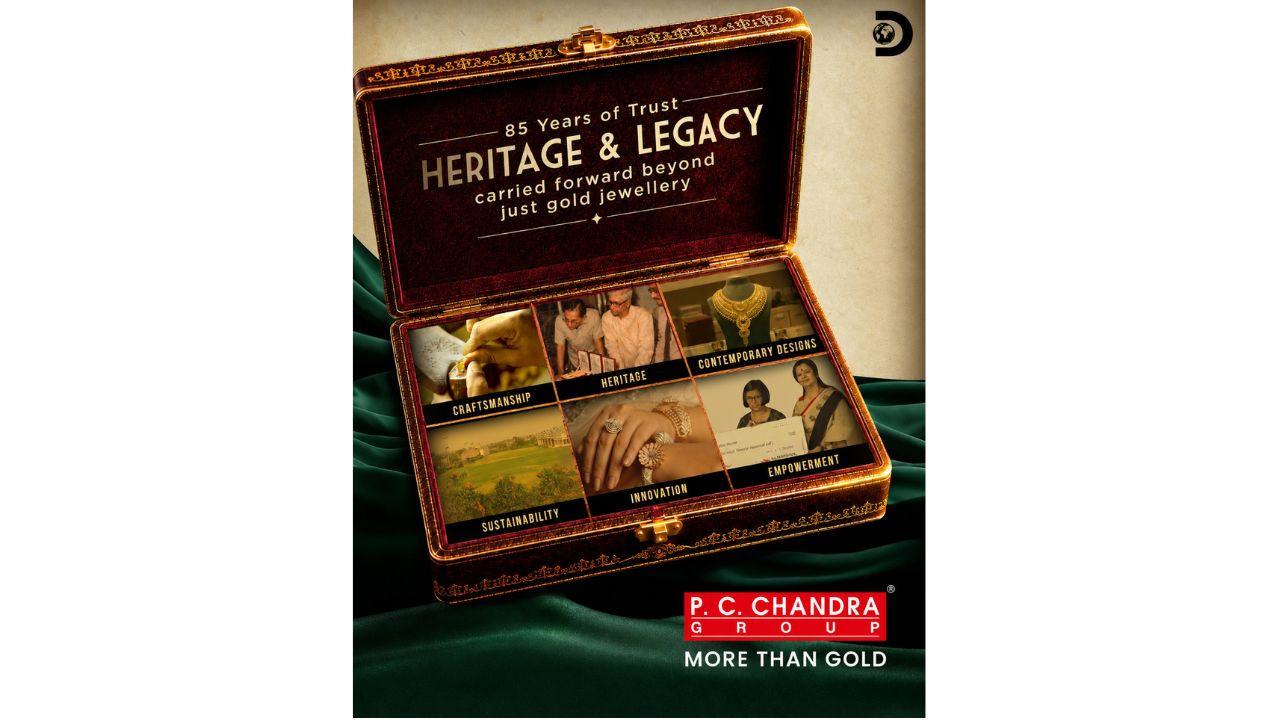
Celebrating over 85 years of legacy, P.C. Chandra Group was showcased by Discovery India through P.C. Chandra – More Than Gold, which premiered on Warner Bros. Discovery followed by their social media platforms and on P.C. Chandra Jewellers’ YouTube channel. "Founded in 1939 as a jewellery business, P.C. Chandra has evolved over the past eight decades into one of India's leading diversified business groups, with interests spanning jewellery, chemicals & adhesives, hospitality, software, real estate, plantations, and social greenery. While expanding across industries, the Group has remained steadfast in its commitment to trust, quality, innovation, and customer relationships” A.K. Chandra, Managing Director, P.C. Chandra Group. The Group expressed its honour at being featured by Discovery India through More Than Gold, describing it as an opportunity to showcase the philosophy that has guided P.C. Chandra’s journey over the decades. The feature highlighted the Group’s evolution beyond a business enterprise into an institution driven by responsible business practices, innovation, social development, sustainability, and purposeful diversification. It also reflected a legacy of resilience, trust, and values that has enabled P.C. Chandra to create lasting social and economic impact while contributing to nation-building across generations. Guided by its ‘More Than Gold’ philosophy, the Group is committed to creating a positive social impact through several CSR initiatives, including the J.L. Chandra Merit Scholarship (awarding scholarships to Madhyamik Examination toppers), J N Chandra Anuprerna (scholarships for needy students), Gyandhara (knowledge centres in colleges), Neem Banani (promoting a greener environment). The Group also contributes to the healthcare sector by providing essential equipment to various hospitals and extending support to a nursing school run by Calcutta Heart Clinic. These efforts are intended to support healthcare infrastructure and, in a modest way, contribute to the well-being of society. Video Links: P.C. Chandra Jewellers: Discovery India: Disclaimer: The views and opinions expressed in the article are media marketing initiative and do not represent the stand and views of Mid-Day Group. Mid-Day Group disclaims any and all liability to any party, company or product for any direct, indirect, implied, punitive, special, incidental or consequential damages arising directly or indirectly from the use of this content.
17 August, 2026 12:53 PM IST
Look closely at a carving of Kali on an old South Indian temple wall and you'll find a string of skulls resting against her chest. Look at the hand of someone walking out of a metal gig in Bengaluru and you might find one cast in silver. Same symbol, a thousand years apart. Skull symbolism is one of the oldest visual languages people share - yet two civilisations built almost opposite meanings on top of it. In India, the skull stood for power over death. In medieval Europe, it became a warning about death. Both readings survived. They sit on temple walls, in museum cabinets, and on the rings people slip on every morning without thinking twice about where the shape came from. India Wore the Skull First Long before the skull reached a pirate flag or a biker's jacket, it sat in the iconography of Hindu deities - and it never meant what most people assume. Shiva in his fierce form as Bhairava, and the goddess Kali, are both shown wearing a mundamala: a garland of severed heads or skulls. It looks gruesome to an outside eye. Inside the tradition, it's the opposite of morbid. Kali's garland is usually counted at fifty, sometimes fifty-two. Those heads stand for the fifty letters of the Sanskrit alphabet - the full set of sounds from which language, and therefore creation, is built. The skull here isn't a trophy. It's a statement that the goddess holds the whole of sound, speech and reality. Death is just one note in that range, not the end of the song. The Skull Cup and the Cremation Ground The thread runs deeper with the Kapalikas - literally the "skull-bearers" - a Tantric Shaiva order that took shape in medieval India somewhere between the 4th and 8th centuries. They carried a kapala, a cup made from a human skull, and meditated in cremation grounds. Their living descendants, the Aghori, still do. The point of drinking from a skull was never shock. It was practice. If you eat from the thing your own head will one day become, you stop flinching at it. The ego loosens its grip. And if the divine is truly everywhere - Shiva in a fresh flower and equally in a rotting corpse - then nothing is impure, and death holds no special horror. In years of fitting men for silver rings, I've watched the people who reach for a skull design split into two camps: those who know exactly this history, and those who just feel the pull of it without the footnotes. So Why Did Europe Turn the Skull Into a Warning? Europe took the same shape and read it backwards. The earliest memento mori rings appeared in the 15th century, carrying skulls and the Latin line remember you must die. Where the Indian skull says you are more than your body, the European one says your body is running out of time, so behave. That message hardened into a whole craft. By the 17th century there were rings with tiny enamel coffins that opened onto skeletons. The Georgian era, roughly 1714 to 1837, softened the skulls into urns and weeping willows; the Victorians, after Prince Albert's death in 1861, built an entire mourning-jewellery industry on the idea. Different century, same instinct - wear death where you can see it, and you'll live more carefully. The Same Skull Symbolism, Two Opposite Readings Put the two traditions side by side and the contrast is almost clean enough to be a diagram. The object is identical; the skull symbolism stacked on top of it is inverted. Indian / Tantric reading European memento mori reading Core message Power over death; the body is temporary, the self is not "Remember you must die" - a warning to live well Worn by Shiva and Kali (mundamala); Aghori ascetics (kapala) Mourners and the pious (15th–18th century rings) Emotional tone Fearlessness, transcendence Humility, reflection What the skull denies The ego's fear of dying The vanity of worldly life What's interesting is that both readings end up at the same practical place: stop being ruled by the fear of death. One gets there through transcendence, the other through humility. And that shared destination is exactly why the symbol still travels so well - it carries on as hand-cast gothic rings in sterling silver that a buyer in Bengaluru and a buyer in Berlin can both read, even if each fills in a slightly different meaning. How the Skull Ring Reached Bengaluru's Metal Stages India never really lost the skull - it just moved venues. And few cities show that better than Bengaluru, which has carried a reputation as the home of India's rock and heavy-metal scene for decades. If you want the long version of how the motif jumped from devotional art to daily wear, Bikerringshop's guide to what a skull ring means traces that route in detail. The local credentials are real. Kryptos, formed in Bengaluru in 1998, became the first Indian heavy-metal band to play Wacken Open Air in Germany in 2013. Four years earlier, in 2012, the city had launched Bangalore Open Air - India's only dedicated open-air metal festival. Built with Wacken itself, it has pulled in names like Kreator and Napalm Death. A scene like that needs its own uniform. Heavy silver rings, skull motifs and oxidised finishes became shorthand for belonging, the same way a temple carving once signalled which deity you served. So the man wearing a skull ring to a gig at the edge of the city is, knowingly or not, standing at the end of a very long line. Kali's garland, the Aghori's cup, the European mourning ring, the metalhead's silver - all the same shape, asked to mean slightly different things by each generation that picked it up. What a Skull Ring Says When You Wear One Now Strip away the history and a modern skull ring still does one quiet thing: it puts mortality on your hand where you'll glance at it. Most pieces sold today are solid sterling silver - .925, meaning 92.5 percent pure silver - and a substantial men's design runs anywhere from about 30 to 80 grams. That weight matters more than it sounds. A skull you can feel pulling on your finger reads very differently from a flat printed one. It's worth being honest about what the ring is and isn't. Worn outside a temple or an order, a skull ring isn't a religious object, and nobody should pretend it carries the charge an Aghori's kapala does. What it carries is the echo - a small, daily reminder that fear of death is optional, which is precisely the idea both India and old Europe were circling. People reach for it for confidence, for memory of someone gone, for the plain fact that it looks like nothing else on a hand. Worth knowing: A skull's meaning shifts with its face. A grinning skull tends to read as defiance or humour in the face of death; a calm, closed-eyed one reads closer to the Indian idea of acceptance. The expression you choose says more than the material does. Frequently Asked Questions Is a skull a symbol of death or power? Both, depending on the culture. In Hindu and Tantric tradition the skull signals power over death - impermanence of the body, not the end of the self. In medieval European memento mori art it signalled mortality as a warning. The same shape, two near-opposite messages. Why does Shiva - and Kali - wear a garland of skulls? The garland is called a mundamala. Kali's roughly fifty heads represent the fifty letters of the Sanskrit alphabet, marking her as the source of all sound and creation. On Shiva's fierce Bhairava form it signals mastery over time and death rather than any celebration of killing. What does wearing a skull ring mean today? Usually it's a personal reminder rather than a religious one - confidence, remembrance of someone lost, or a nod to memento mori's "live fully, you won't last forever." Subculture matters too: in metal and biker circles a heavy silver skull ring reads as a badge of belonging. Are skull rings religious? Not inherently. The motif has deep roots in Hindu, Tantric and Christian art, but a modern silver skull ring is a fashion and cultural object, not a sacred one. It borrows the symbol's meaning without carrying the ritual weight of a temple icon or an ascetic's skull cup. The Symbol Was Never Ours to Invent The skull on a ring feels modern, even a little rebellious. It isn't. Every generation that inherited this skull symbolism - temple sculptors, Tantric ascetics, Georgian widows, a thrash guitarist in Bengaluru - bent it toward its own fear or its own freedom. Wear one and you're not making a new statement. You're joining a very old conversation about the one thing none of us gets out of, and choosing, like all of them did, to look at it on purpose. Tepparit Kacha has spent more than 15 years working with sterling silver and men's statement jewellery, with a particular focus on the symbolism behind the designs people choose. He curates handcrafted pieces at Bikerringshop. Disclaimer - This is a promotional/advertorial feature. The views, opinions, historical interpretations and product references expressed herein are solely those of the advertiser/author.The Publisher does not independently verify or endorse any statements, claims or representations contained in this content and accepts no responsibility or liability arising therefrom.
18 July, 2026 04:24 PM IST
Faith Met Fashion on the Cannes Red Carpet: Annisha Garg at Cannes 2026
26 May, 2026 04:13 PM IST

Yash Ahlawat Congratulates Honorable Amit Shah on BJP’s Success in West Bengal and Assam
05 May, 2026 08:03 PM IST

Travel Season And Pet Anxiety: What Pet Parents Should Know
28 February, 2026 05:07 PM IST

5 Trendy Sarees to Opt from Priyangaa This Season
13 January, 2026 01:47 PM IST
ADVERTISEMENT
Which Dirndls are Out of Style in Modern Trachten Fashion?
24 December, 2025 08:29 PM IST

How One Mom Built India’s Most Loved Handcrafted Kidswear Brand in Under a Year
26 November, 2025 07:34 PM IST

Redefining Indian Fashion: Meet the Designers Shaping the Industry
25 October, 2025 05:28 PM IST

Boonne Fashions Set to Redefine India’s Premium Fashion Landscape
23 October, 2025 11:57 AM IST
ADVERTISEMENT
ADVERTISEMENT