Home / Entertainment / Bollywood News / Article /
Making of 'Sholay': Tales from masala bay
Updated On: 07 March, 2014 09:00 AM IST | | Siddharth Bhatia
An excerpt from Sidharth Bhatia’s book, 'Amar Akbar Anthony — Masala, Madness and Manmohan Desai', gives an insight into the events that led to the making of this cult film





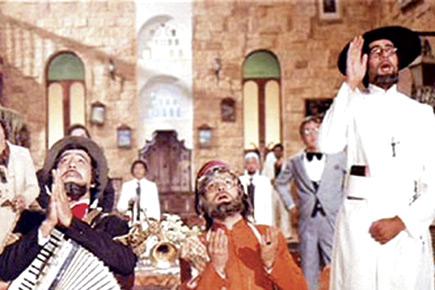
A still from 'Amar Akbar Anthony' (1977)
Chapter 3.
Making the Film
 As word spread in the industry that Manmohan Desai was making a fourth film in the year, his peers and others, as is the norm in the business, scoffed at everything — the name, the idea and the fact that he had taken three superstars in it. Even the female leads were big names: Neetu Singh, Parveen Babi and Shabana Azmi, who was to be Vinod Khanna’s love interest. The first reaction in the industry is usually to pick holes in a project; often it is borne out of envy, especially when a producer has managed to sign up top stars. The choice of Azmi was a bit surprising, even if she was working in Desai’s other film, Parvarish. An alumnus of the Film and Television Institute of India, she had become one of the key actors in the Indian ‘new wave’ cinema, making her debut in Ankur, a film about rural exploitation. Her portfolio consisted mainly of small-budget, art-house films, which made her popular among critics and discerning audiences but did not translate into mass recognition. The two worlds of art films and mainstream commercial films did intersect and both viewed each other with wariness, if not hostility. The directors of ‘art’ films scoffed at the masala films, calling them lowbrow and exploitative; the latter returned the compliment, declaring the new-wave directors as self-indulgent pseudo-intellectuals, a dig at the fact that many of these films did not do well at the box office. Actors and even technicians belonged squarely in one camp or the other. The lines would eventually get blurred, as more and more new-wave directors, conscious of the need for box-office success, began to use big stars in their films, but in the mid-1970s, the two streams were mutually exclusive. Shabana Azmi had made tentative crossings to Amar Akbar Anthony on the other side, but was seen as firmly entrenched in the art world. Yet she was excited to get this offer.
Trending Stories
Latest Photos
Latest Videos
Latest Web Stories
ADVERTISEMENT

Ganeshotsav 2026

ADVERTISEMENT