A few interesting facts about the Wright Flyer
Updated On: 17 December, 2015 08:15 AM IST | | A Correspondent
Aviation history was made today on December 17 in 1903, when the Wright brothers, Orville and Wilbur Wright made their first controlled powered, heavier-than-air flight in the Wright Flyer at Kitty Hawk, North Carolina, USA





Wright Brothers, The Wright Flyer, aviation history, special feature, Kitty Hawk, North Carolina, Orville Wright, Wilbur Wright
Aviation history was made today on December 17 in 1903, when the Wright brothers, Orville and Wilbur Wright made their first controlled powered, heavier-than-air flight in the Wright Flyer at Kitty Hawk, North Carolina, USA.
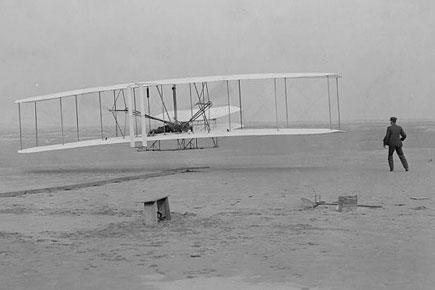
The 1903 Wright Flyer also referred to as Flyer I or 1903 Flyer flew forward without losing speed and landed at a point as high as that from which it started. With Orville Wright as pilot, the airplane took off from a launching rail and flew for 12 seconds and a distance of 37 meters (120 feet).

The photograph of American aviators Wright brothers, Orville and Wilbur, make the first flight successfully in a heavier-than-air-machine, The Wright Flyer on December 17, 1903 at Kitty Hawk, in a flight of 70 metres. Pic/AFP
The original 1903 Wright Flyer is the centerpiece of "The Wright Brothers & The Invention of the Aerial Age" exhibition at the Smithsonian's National Air and Space Museum's flagship building in Washington, DC.
In March 1999, a full-scale replica of the 1903 Wright Flyer was mounted in NASA Ames Research Center's 40-foot by 80-foot wind tunnel for tests to build a historically accurate aerodynamic database of the Flyer. For two weeks, engineers studied the replica's stability, control and handling at speeds up to 27 knots (30 mph) in the wind tunnel. The Wright Flyer replica was constructed by a team of volunteers from the American Institute of Aeronautics and Astronautics using plans provided by the Smithsonian. The replica featured a 40-foot-4-inch wingspan reinforced with piano wire, cotton wing coverings, spruce propellers and a double rudder. Although it replicated the 1903 Wright Flyer in design, size, appearance and aerodynamics, some changes were made to make it stronger for mounting in the wind tunnel.
Trending Stories
Latest Photos
Latest Videos
Latest Web Stories
ADVERTISEMENT
Mid-Day Fast
ADVERTISEMENT