shot-button
T20 World Cup 2026 Article Details T20 World Cup 2026 Article Details
Home > News > India News > Article > Behind bars forgotten disabilities

Behind bars, forgotten disabilities

Updated on: 09 March,2026 08:03 PM IST  |  Mumbai
Vinod Kumar Menon | vinodm@mid-day.com

New review exposes how prison systems across states fail to recognise or accommodate disabled prisoners

Behind bars, forgotten disabilities

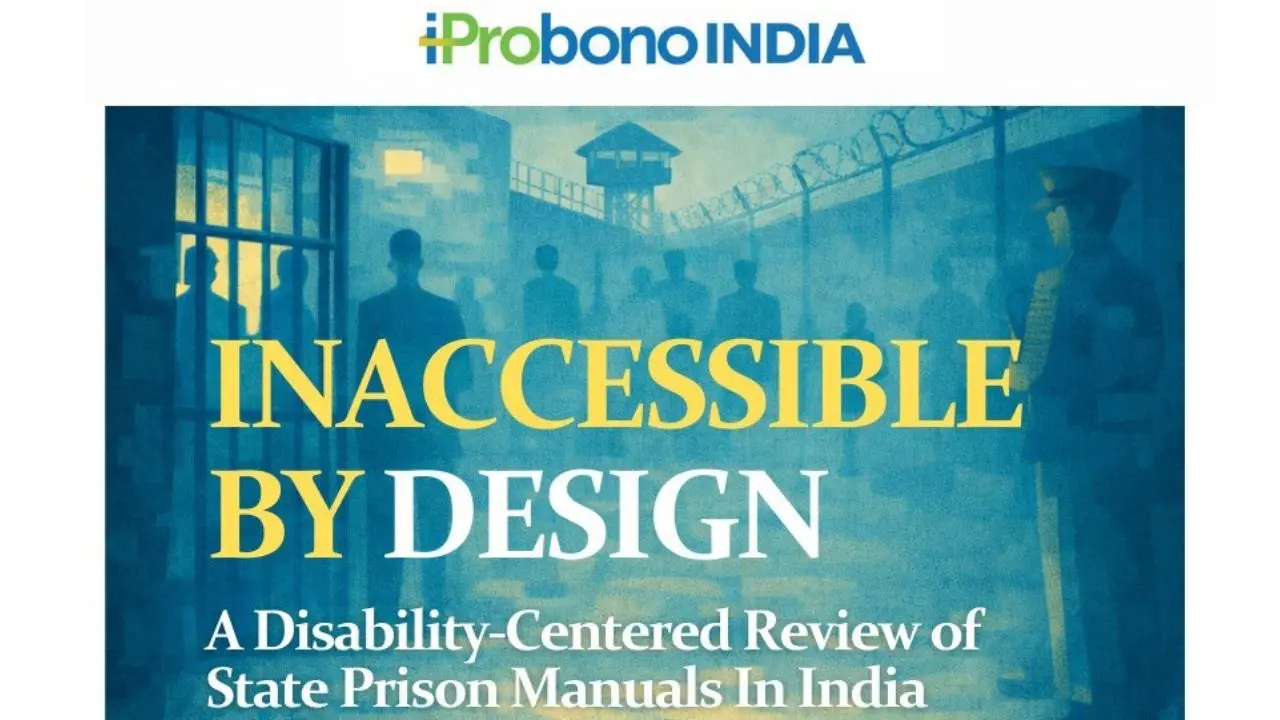
iProbono review exposes how prison systems across states fail to recognise. (Pic/iProbono)

Listen to this article
Behind bars, forgotten disabilities
x
00:00

Behind the iron gates of India’s prisons lies a quieter injustice, one that rarely makes it into police records, court files, or prison registers. Persons with disabilities (PwDs), particularly those with mental health conditions, are entering the criminal justice system largely unseen, unrecorded, and unsupported.

On Monday (March 9) a new review by iProbono India, a Delhi-based, women-led social justice organisation, titled “Inaccessible by Design – A Disability-Centred Review of State Prison Manuals in India", exposes deep structural failures across prison systems in Maharashtra and the rest of the country. The report examined prison manuals in 35 states and Union Territories, measuring them against the standards of the Rights of Persons with Disabilities Act, 2016.


What emerges is a disturbing portrait; disability is rarely identified at the earliest stage of the justice process, from FIRs (First Information Reports) to arrest memos, leaving thousands of vulnerable individuals trapped in a system that neither recognises nor accommodates them.


Maharashtra- Where the system begins to fail

In Maharashtra, one of India’s largest prison systems, mental health screening at admission remains inconsistent and poorly structured, a pattern mirrored nationwide.

Across India, only 11 out of 35 states and Union Territories require any form of mental health screening when a person enters prison. Even where such screening exists, it is usually conducted by a prison medical officer with no requirement for a trained psychiatrist or clinical psychologist.

The consequences are severe: prisoners with psychosocial disabilities may go undiagnosed, untreated, and misunderstood – often misclassified as security risks rather than individuals needing care.

A law that exists only on paper

The iProbono latest report further reveals that India already has legal safeguards. Section 103 of the Mental Healthcare Act, 2017, requires prisons to conduct

•    Physical and mental health examinations at admission

•    Substance-use assessments

•    Drug testing with periodic follow-ups

Yet prison manuals across states, including those influencing prison administration in Maharashtra, fail to implement these mandates in practice.

Most manuals lack:

•    Frameworks to identify psychosocial or neurodivergent conditions

•    Requirements for trained mental health professionals

•    Standardised diagnostic tools

Among all states, Karnataka stands alone in providing a standardised screening tool, while Tamil Nadu is the only state to explicitly mention trained psychologists or social workers during admission.

Mid-Day’s earlier reports

Mid-Day had earlier, in April 2023 and October 2022, written a series of stories on the issue; for instance, in April 2023

Maharashtra: One psychiatrist for 42,577 inmates in 64 prisons

The state has also not implemented the Mental Healthcare Act, which mandates a mental health unit in at least one prison.

Also Read: Maharashtra: One psychiatrist for 42,577 inmates in 64 prisons

October 2022

‘India doesn’t spend even Rs 100/day on a prisoner’: How can access to medical care in prisons be improved?

What’s it like to be old and imprisoned in India? Latest statistics on medical care available inside Maharashtra’s jails paint a familiar, worrying picture.

Also Read: ‘India doesn’t spend even Rs 100/day on a prisoner’: How access to medical care in prisons can be improved?

Disability used as a reason for exclusion

Instead of enabling access, prison policies across India frequently exclude prisoners with disabilities from opportunities that could improve their lives.

In Karnataka (2021) and West Bengal (1992), prisoners deemed “mentally or physically unfit” are barred from mandatory educational programmes, the report states.

Across seven states and Union Territories, prisoners with mental illness are explicitly excluded from parole and furlough.

In six states, those with mental health conditions are barred from open or semi-open prisons, facilities designed to support rehabilitation and reintegration.

Disability, the report notes, is treated not as a status requiring accommodation, but as a disqualification.

Isolation instead of care

In 17 states and Union Territories, prison manuals mandate segregation of prisoners with mental illness.

Instead of receiving specialised care, these individuals are often confined to:

•    Isolation cells

•    “Contagious” wards

•    Cells housing high-risk or “dangerous” prisoners

Such segregation often occurs without safeguards, oversight, or medical justification.

Who decides a prisoner must be isolated?

In a system that holds thousands of vulnerable individuals, the power to segregate them often rests with prison authorities alone.

In 17 out of 18 states, prison staff can decide whether a prisoner with a disability should be isolated.

•    No mandatory mental health assessment

•    No consultation with specialists

•    No independent review

Only Uttar Pradesh requires consultation with a medical officer, yet no state requires a trained mental health professional for such decisions.

The invisible prisoners

The findings reveal a system where disability is almost invisible.

Key gaps across India’s prison manuals include the following:

•    Little or no mental health screening at admission

•    Absence of trained mental health specialists in assessments

•    Continued use of ableist terminology

•    Blanket exclusions from education, parole, furlough, and open prisons

•    Routine segregation and isolation of prisoners with mental illness

A national conversation long overdue

For advocates, the problem extends beyond prison walls. The failure to recognise disability begins earlier — during policing and arrest — and continues through legal aid and court proceedings.

The report calls for urgent reforms across the criminal justice system, emphasising that access to justice for persons with disabilities must include:

•    policing procedures

•    prison administration

•    legal aid systems

•    judicial processes

Until then, thousands of prisoners with disabilities, including those in Maharashtra, will remain trapped in a system built without them in mind. 

i-Probono program manager speaks

Karuvaki Mohanty, Program Manager, iProbono India

"Prisoners with disabilities face heightened vulnerabilities within custodial settings, where the absence of reasonable accommodation creates a compounding layer of hardship. This is further aggravated for those with invisible disabilities; without identification or awareness, their needs remain unseen and their right to specific accommodations unmet. Our review of 35 State Prison Manuals reveals a systemic failure to move beyond framing disability as a 'risk', highlighting the urgent need for a structural redesign that centres dignity and access to justice for persons with disabilities across the entire criminal justice continuum," Karuvaki Mohanty, Program Manager, iProbono India, and Shrutika Pandey, Consultant iProbono, said.

"Exciting news! Mid-day is now on WhatsApp Channels Subscribe today by clicking the link and stay updated with the latest news!" Click here!

Did you find this article helpful?

Yes
No

Help us improve further by providing more detailed feedback and stand a chance to win a 3-month e-paper subscription! Click Here

Note: Winners will be selected via a lucky draw.

Help us improve further by providing more detailed feedback and stand a chance to win a 3-month e-paper subscription! Click Here

Note: Winners will be selected via a lucky draw.

maharashtra home ministry India news news health

Mid-Day Web Stories

Mid-Day Web Stories

This website uses cookie or similar technologies, to enhance your browsing experience and provide personalised recommendations. By continuing to use our website, you agree to our Privacy Policy and Cookie Policy. OK