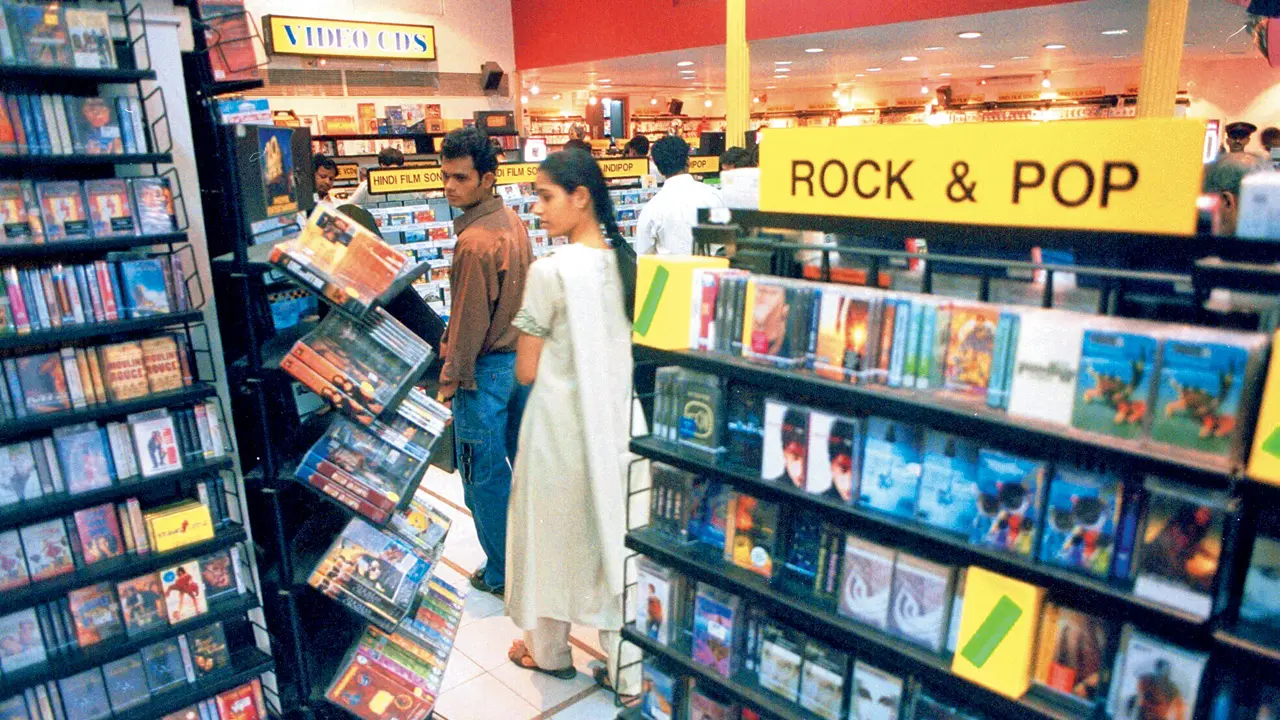
Mumbai’s cosmopolitan history aside, it was sad to see Rhythm House, where I heard so much of the 1960s music, shuttered up, and Thacker, a book shop that held wonderful memories, no more

The Rhythm House music store, which closed down in 2016. PIC/MID-DAY ARCHIVES
A strange and totally unexpected thing happened to me in Mumbai last week. Walking from the Gateway of India to Flora Fountain, I fell. The pavement was dreadfully uneven, full of holes, and I had stumbled on one and was lucky not to suffer a serious injury. After the fall, my wife was so worried that as we went round Mumbai, she held my hand, making me feel very old indeed.
I mention this because I am a Midnight’s Child, born seven months before India won freedom, and lived in Mumbai until I was 21. During this period, that road, and much of South Mumbai, was my regular haunt, and I cannot remember worrying about the condition of any pavement. I did occasionally fall but that was when playing cricket at the Oval Maidan. I would have dismissed any talk of Mumbai’s streets being too dangerous to walk on as nonsense. Now I agree with a Mumbai friend that in the city, you must always walk with your head down, eyes glued to the pavement, to make sure you do not fall.
However, minutes after the fall, having negotiated a pavement worse than a building site, the Bombay that has become Mumbai, unexpectedly, revealed itself. In the Bombay of my youth, which I describe in my memoir, Thank You Mr Crombie: Lessons in Guilt and Gratitude to the British, hawkers went round shouting “foreign, foreign” holding out the riches of the west which we so desperately craved. Now here was the elegant showroom of Fabindia where foreigners throng to get things they cannot at home. As my wife and our friend did just that, I sat on a comfortable chair talking to a member of a Soul Group touring India.
Unimaginable in my youth.
As we left Fabindia there was Kala Ghoda, a wonderful example of Mumbai reconciling India’s complicated history. When I grew up, the black stone statue of King Edward VII seated on a black horse was one of Bombay’s most prominent statues. It was nearly two decades after independence that it was finally consigned to Byculla Zoo. The old Kala Ghoda, built to honour the visit of Edward VII, then Prince of Wales, glorified British rule. The new black horse has no rider and stands for something very different. This Kala Ghoda proclaims India’s emergence as a free nation. The chowk is named after Netaji, who raised an army to fight for India’s freedom, and you could picture him sitting on a horse as he gave his clarion call to his army, “Chalo Delhi”. This means a lot to me as I wrote the first comprehensive biography of Netaji, The Lost Hero.
But Mumbai is missing a trick. A few days before my fall, Narendra Modi told the Israeli Knesset of how India was the only country that had never discriminated against Jews. I was aware of it and in my memoir talk about how I discussed Indian-Jewish relations with my sister’s best friend, Shirley, a Jewish woman, in love with a Hindu boy. But India went further. It provided Jewish immigrants the chance to shine. Kala Ghoda was financed by Albert Sassoon, whose father David, an Iraqi Jew, had fled Baghdad because of antisemitism. Sassoon was not the only Iraqi Jew to prosper. Mumbai has given Britain Anish Kapoor, one of its greatest sculptors, whose mother was an Iraqi Jew.
But while I felt pride in Mumbai’s cosmopolitan history, it was sad to see in the street behind Kala Ghoda, Rhythm House, where I heard so much of the music of the 1960s, shuttered up, and Thacker, the book shop where I enjoyed the wonderful sensation provided by new books, no more.
Perhaps the greatest contrast between the old and the new came at the CCI. For me it will always be the home of cricket. I shall never forget sitting in the North Stand on that magical Dussehra Day in 1964, cheering India to victory over Australia. Even after 50 years of reporting cricket, including the 1983 World Cup triumph at Lords, that remains special.
In the evening sunlight, I could see CCI has not changed. Members walked round the ground having their evening constitutional, while dotted around were other members sitting on lovely cane chairs having drinks. It was while sitting on a CCI chair in 1978 that I advised Khalid Ansari to start mid-day and take on the Evening News of India. He listened to my advice and the rest is history.
I regret CCI is no longer the home of Indian cricket, but even more that such is the dominance of IPL and international cricket, that grassroots cricket, at clubs, schools and universities, is less publicised.
This reinforced my feeling that while Mumbai changes, and often for the better, it seems to want to scrub its past. Mumbai should heed the warning of [Spanish philosopher] George Santayana, “those who forget the past are condemned to repeat it”. I would not wish that on my beloved Mumbai and it could start by repairing its pavements.
Mihir Bose is a London-based writer who, in 1990, wrote The History of Indian Cricket, the first narrative history of Indian cricket.
He tweets @mihirbose. Clayton Murzello’s Pavilion End will be back next week.
The views expressed in this column are the individual’s and don’t represent those of the paper.
Subscribe today by clicking the link and stay updated with the latest news!" Click here!