Tick-tock, where’s the clock?
Updated On: 14 April, 2026 07:40 AM IST | Mumbai | Fiona Fernandez
The coming generations in the city will never realise the relevance of public clock towers, and how citizens benefited from their presence in their everyday lives





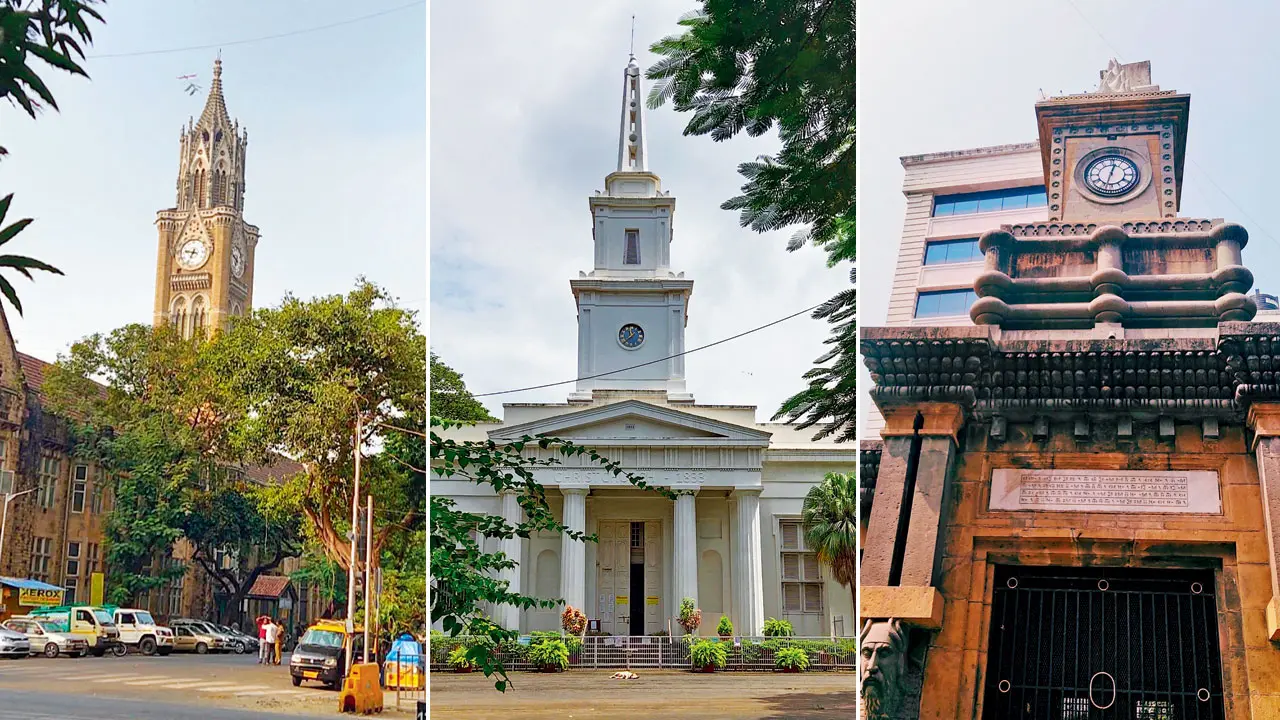
(Left) The Rajabai Clock Tower has the city’s largest dial at 13.5 feet in diameter, and its pendulum measures 14 feet; (centre) the Christ Church clock was manufactured in Clerkenwell, London, which was one of the centres of clock- and watch-making in England; (right) the Bomanjee Hormarjee Wadia Clock Tower was built by public funding and erected in honour of a Parsi philanthropist in whose name it stands. Pics/Fiona Fernandez
 The surprising response to a question in a quiz was alarming, as much as it was eye-opening. The venue was the swanky AV room of an international school in a western suburb. As part of a visual, Mumbai-themed quiz, a question to name the famous clock tower facing Oval Maidan was posed to middle-schoolers. I was expecting it to be a ‘sitter’, to use quizzing parlance. Quite the contrary happened. All that wafted across the room after the question was dropped, were a range of incorrect chirps by voices emanating from blank faces. Even Big Ben was thrown in as a possible answer. If you’re still wondering, the correct answer is Rajabai Tower. As I began to explain the relevance of this landmark to the group, I realised that they, and the coming generations, would never realise the importance of clock towers in context to our cityscapes, and how its citizens literally, ‘looked up’ to them, in more ways than one.
The mind immediately wandered back to two years ago, when I had interacted with Hyderabad-based horologist Venkatesh Rao, who returned to Mumbai to work his magic on Byculla’s Christ Church clock. At the time, this ‘OG tick-tocker’ [we couldn’t resist the word-play], succeeded in making it the oldest operational public timepiece in the city.
Trending Stories
Latest Photos
Latest Videos
Latest Web Stories
ADVERTISEMENT

Ganeshotsav 2026

ADVERTISEMENT