Time IMA demanded affordable medical education
Updated On: 07 March, 2022 07:13 AM IST | Mumbai | Dharmendra Jore
The doctors’ association’s call should go beyond a suggestion that Indian medical students in Ukraine be accommodated in the country’s colleges as a one-time measure





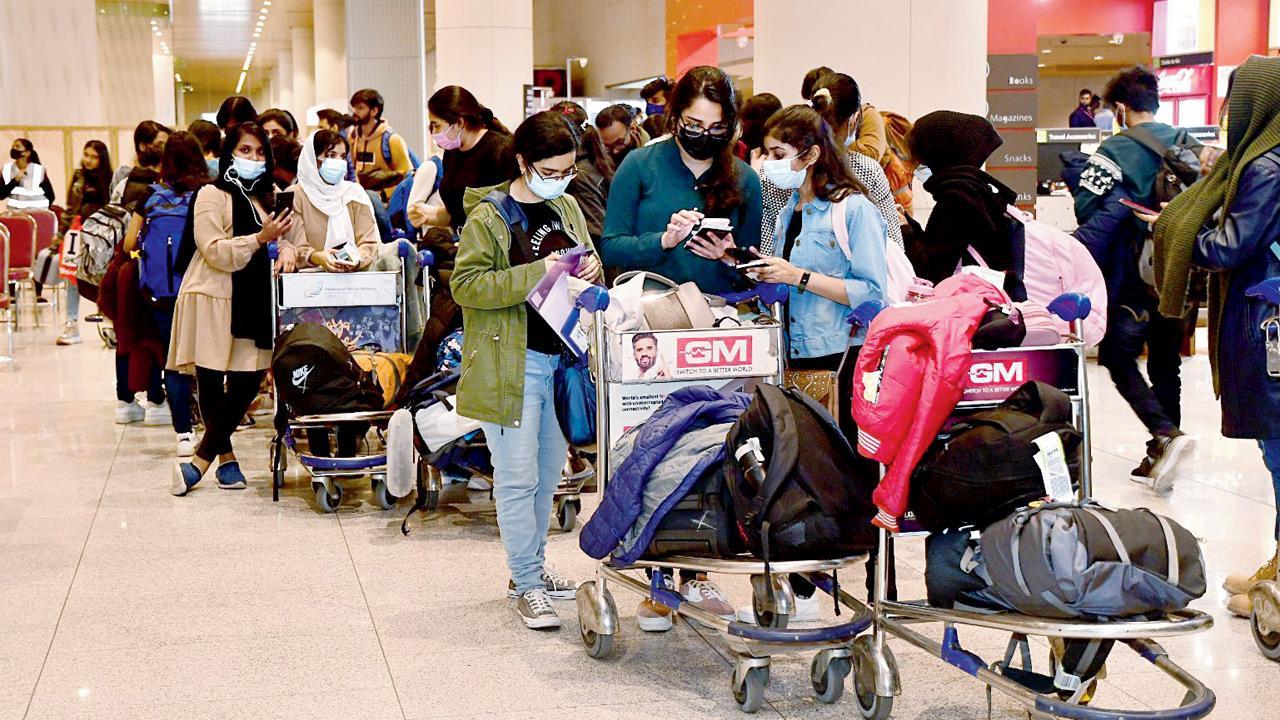
Indian students evacuated from Ukraine arrive in Mumbai on Sunday. Pic/ANI
 In a welcome move, the Indian Medical Association (IMA) has urged Prime Minister Narendra Modi to allow medical students returning from war-hit Ukraine to be accommodated in the colleges in India as a one-time measure. Now, it’s time the IMA took up the demand for providing affordable medical education in the country. It should tell the PM that to achieve this affordability, the country needs at least one government medical college (MBBS degree) in each big district, where seats for post graduation can also be created when they fulfil the norms. As of now, the ratio of affordable government and highly expensive private medical colleges is almost 50:50. Besides, in addition to government and private medical colleges, private institutes, which are given PG seats costing a bomb for students, are mushrooming. The fees for undergraduate and PG courses in private medical colleges is much higher than in the government colleges in India and countries like Ukraine where over 18,000 Indian students are at the various stages of their courses. Most of them have returned home to face an uncertain future.
The IMA is considered the most influential superstructure of allopathy doctors (MBBS, specialists and super specialists). Its members work in hospitals and medical colleges run by the government, semi-government, private and corporate entities. The members also practise individually in the urban, semi-urban and rural areas. They know well about the quality and quantity we need to make healthcare affordable in the country of 140 crore people. Parliament was informed last winter that the doctor-patient ratio in India was 1:834, better than the World Health Organization’s recommendation, assuming 20 per cent availability of 13 lakh allopathy doctors and 5.56 lakh Ayush doctors. The number of allopathy doctors may appear bigger than others, but we are still behind the WHO-prescribed ratio of 1 MBBS doctor per 1,000 patients. We plan to achieve it by 2024. The question is even if we achieve the ratio, how many of the allopathy doctors, especially specialists, will be affordable to the economically weaker sections (EWS) of the society?
Trending Stories
Latest Photos
Latest Videos
Latest Web Stories
ADVERTISEMENT
Mid-Day Fast
ADVERTISEMENT