shot-button
IPL 2026 Article IPL 2026 Article
Home > Sunday Mid Day News > 5 Subject Specific Jeopardy Templates Every Middle School Teacher Should Bookmark

5 Subject-Specific Jeopardy Templates Every Middle School Teacher Should Bookmark

Updated on: 09 April,2026 07:09 PM IST  |  Mumbai
Nasrin Modak Siddiqi | smdmail@mid-day.com

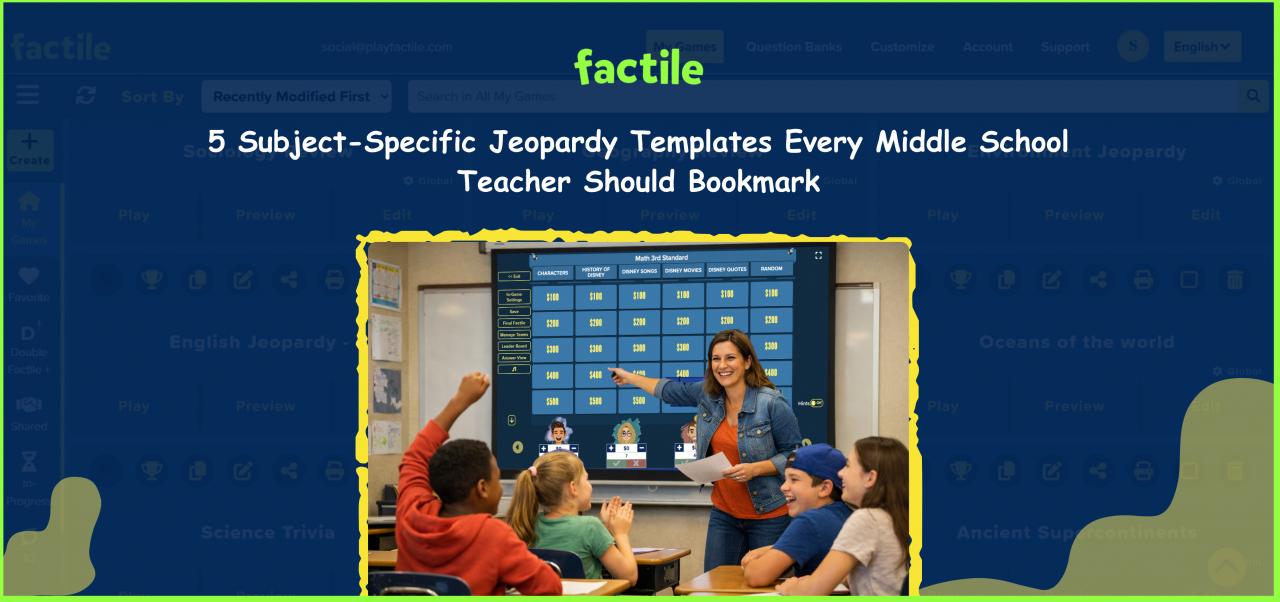
Looking for a way to wake up your students? These 5 subject-specific Jeopardy templates are life-savers. Use our Jeopardy maker to simplify your Friday review.

5 Subject-Specific Jeopardy Templates Every Middle School Teacher Should Bookmark

Online Games

Listen to this article
5 Subject-Specific Jeopardy Templates Every Middle School Teacher Should Bookmark
x
00:00

We’ve all been there. It’s 1:30 PM, the sun is hitting the classroom windows just right, and half of your middle schoolers are staring into space like they’ve been hypnotized. The "afternoon slump" is a formidable foe, but it has one major weakness: the "Jeopardy!" theme song. The moment those first few notes hit, the energy in the room shifts. Suddenly, students are leaning forward, desks are becoming buzzers, and quiet kids are ready to compete for the "grand prize" (which we all know is usually just a sticker or five minutes of free time).

Work Smarter, Not Harder


In the past, bringing this game to life meant spending your entire Sunday night wrestling with confusing PowerPoint animations and manual slide transitions. One wrong click and the whole game board would break.


Thankfully, those days are over. Using an online Jeopardy game maker changes the game. literally. Instead of manual formatting, these tools allow you to:

  • Save hours of prep time by using pre-made templates.
  •  
  • Auto-calculate scores so you don't have to be a math teacher and a game show host at the same time.
  •  
  • Keep students engaged with polished visuals and sound effects that work every time.
  •  
  • You get to keep the "magic" of the game while getting your weekend back.

Why Using a Jeopardy Maker is a Game-Changer

Let's be honest: middle schoolers aren't exactly known for their love of long, quiet worksheets. If you want to capture their attention, you have to compete with TikTok and video games. That’s where a digital Jeopardy maker steps in to turn a routine review into the event of the week.

1. High Energy, High Engagement

When you swap a paper packet for a digital game board, you move from passive listening to active participation. Instead of students hiding behind their notebooks, they are collaborating with teammates, debating answers, and actually wanting to get the question right. It turns "I have to do this" into "I want to win this."

2. The "AutoGen" Advantage

As a teacher, your time is your most valuable resource. Using a Jeopardy maker is like having a teaching assistant.

  • AutoGen Features: Many tools can now generate questions for you based on a topic or a chunk of text.
  • Pre-made Banks: Access thousands of existing games created by other teachers. If you’re teaching "The Water Cycle" or "Civil War Battles," someone has likely already built a great starting point for you.

3. Assessment Without the Stress

Jeopardy is the ultimate low-stakes formative assessment. It allows you to see exactly what the class understands (and what they’re totally confused about) in real-time. Because it’s "just a game," students are more willing to take risks and make mistakes. You get the data you need to plan your next lesson without the "test anxiety" that usually comes with a quiz.

Engagement Levels Comparison

Feature

Traditional Review 

Gamified Review 

Student Focus

Moderate to Low

Very High

Participation

Usually the same 3 kids

The entire class

Energy Level

"Can I go to the bathroom?"

"Can we do one more category?!"

Immediate Feedback

Takes days to grade

Instant

Ready to build your first board? Here are five middle school-approved templates you can create in minutes using an online Jeopardy maker. These are designed to turn "ugh, another lesson" into "wait, let me answer that!"

1. ELA 

This game helps students master the building blocks of the English language. It moves away from simple definitions and asks students to identify how language works in action. The board covers Parts of Speech to strengthen writing, Figurative Language to improve reading comprehension, and Punctuation to polish grammar skills. It turns dry rule-following into a fast-paced identification challenge.

This template is specifically built for 6th to 8th-grade students. It is perfect for teachers who want to move beyond basic multiple-choice questions and challenge students to think critically about word choice and sentence structure.

When to play?

  • Unit Review: Use it as a pre-test review before a major grammar or literature exam.
  • The Mid-Week Slump: Play it on a Wednesday to break up a long week of essay writing.
  • Test Prep Season: It is a fantastic tool for standardized test preparation, specifically for 

2. Science

This game is a deep dive into the natural world. It covers the Periodic Table to help students recognize elements, Ecosystems to show how energy moves through food webs, and Newton’s Laws to explain the physics of everyday life. It is designed to take dense scientific vocabulary and turn it into a fast-paced challenge that helps students see the "big picture" of science.

This template is built for Middle School Science students (6th–8th grade). It works especially well for classes that are preparing for cumulative exams or end-of-year state science assessments.

When to play?

  • End of Unit: Use it to wrap up a module on Forces and Motion or Life Science.
  • Vocabulary Check: Play it mid-unit to ensure students are actually understanding the terms before they get to the lab.
  • Test Prep: It is an excellent tool for the "Science Survey" exams that cover multiple years of learning.

3. Math 

This game takes the "fear" out of math. It focuses on Algebraic Foundations, Ratio Riddles, and Spatial Geometry. Instead of just doing drills, students have to work together to solve problems. It emphasizes the "Order of Operations" and helps students practice mental math under pressure.

It is perfect for 7th and 8th-grade Math students who are transitioning from basic arithmetic to Pre-Algebra. It is also great for remedial groups that need a boost in confidence.

When to play?

  • Friday Math Lab: Use it as a fun way to end the week without a heavy lecture.
  • Homework Review: If you assigned a difficult set of problems, use this game the next day to go over the solutions as a class.
  • Competition Day: Set up a tournament-style bracket to get students excited about solving equations.

4. History 

This game connects the past to the present. It reviews Ancient Civilizations like Egypt and Rome, but also dives into U.S. Civics, including the three branches of government. It helps students understand the difference between primary and secondary sources, which is a key skill for any young historian.

This template is designed for Social Studies and History classes. It is broad enough to be used in a general survey course but detailed enough for a specific Civics unit.

When to play?

  • Historical Milestone Days: Play it at the end of a long historical era (like the Fall of Rome).
  • Election Season: Use the Civics categories during local or national election cycles to explain how government works.
  • Final Exam Review: This is the ultimate "History Time Machine" for a semester-long review.

5. Viral Trends 

This game focuses on the world students live in right now. It covers Modern Media, AI Ethics, and School Culture. It is less about "textbook facts" and more about digital citizenship, critical thinking, and building a positive classroom community.

This is for Advisory periods, Homeroom, or "Brain Break" sessions. It is appropriate for all middle school grade levels and helps teachers build a rapport with their students by talking about things they actually care about outside of school.

When to play?

  • Advisory Friday: Use it as a consistent end-of-week tradition.
  • Rainy Day Recess: When students are stuck inside, this keeps the energy positive and controlled.
  • Community Building: Play it at the start of the year or after a long break to help students reconnect with each other.

How to Choose the Best Jeopardy Game Maker for Your Classroom

With so many digital tools available, picking the right one can feel like a chore. For a middle school classroom, you need something that is fast for you and exciting for them. Here is what to look for when choosing your game maker.

1. Ease of Use: The "5-Minute" Rule

As a teacher, you don't have time for a steep learning curve. The best tools offer a streamlined interface where you can:

  • Create a game in minutes: Look for a "Create Game" button that lets you jump straight into adding categories.
  • Access Templates: A great tool gives you access to a library of millions of pre-made games, so you never have to start from scratch.

2. Accessibility: Works on Every Device

Middle school tech can be a mix of everything. Your game maker should be web-based so it works seamlessly on:

  • Chromebooks and iPads: Students should be able to join using whatever device is in their hands.
  • SmartBoards: The game board should look crisp and professional when projected at the front of the room.
  • Remote Ready: It should work just as well over Zoom or Google Meet as it does in person.

3. Customization

To keep 13-year-olds engaged, the game needs to feel "real." Look for these specific features:

  • Buzzer Mode: This is a total game-changer. It turns student devices into actual buzzers, so the first person to tap their screen gets to answer.
  • Team Mascots: Let students choose fun avatars or upload their own team logos to build classroom culture.
  • AutoGen AI: This is the ultimate time-saver. You can simply provide a topic or upload a lesson PDF, and the AI will automatically generate relevant questions and answers for you.

Conclusion

Bringing a little "game show energy" into your classroom does more than just kill time—it transforms how your students learn. By bookmarking these subject-specific templates, you’re not just preparing for a review session; you’re building a toolkit for higher engagement, better retention, and a lot more laughter in your classroom.

Whether you’re breaking down the complexities of the U.S. Constitution or helping students master the difference between a metaphor and a simile, an online Jeopardy maker takes the heavy lifting out of lesson prep. It allows you to focus on what you do best: teaching and connecting with your students, while the tool handles the scoring, the visuals, and the "ding-ding-ding" of a correct answer.

Stop spending your Sunday nights clicking through manual slides and start tapping into the "magical" power of gamified learning. Your students (and your schedule) will thank you.

Ready to build your own?

Try our Jeopardy game maker today at Factile.

"Exciting news! Mid-day is now on WhatsApp Channels Subscribe today by clicking the link and stay updated with the latest news!" Click here!

Did you find this article helpful?

Yes
No

Help us improve further by providing more detailed feedback and stand a chance to win a 3-month e-paper subscription! Click Here

Note: Winners will be selected via a lucky draw.

Help us improve further by providing more detailed feedback and stand a chance to win a 3-month e-paper subscription! Click Here

Note: Winners will be selected via a lucky draw.

culture news Technology Technology News parenting Lifestyle news Artificial Intelligence

Mid-Day Web Stories

Mid-Day Web Stories

This website uses cookie or similar technologies, to enhance your browsing experience and provide personalised recommendations. By continuing to use our website, you agree to our Privacy Policy and Cookie Policy. OK