Home / Sunday-mid-day / Article /
Face the pandemic like a jawan
Updated On: 29 November, 2020 08:51 AM IST | Mumbai | Prutha Bhosle
Mid Day Short Description





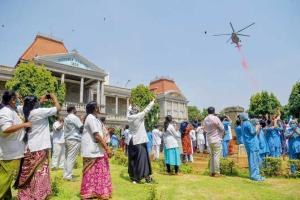
Medical staff and health workers cheer as an Indian Air Force (IAF) Mi-17 helicopter drops flower petals over the Victoria Hospital to pay tribute to frontline warriors fighting against the spread of the COVID-19 infection, in Bengaluru in May. Pic/AFP
According to Oxford University economist Linda Yueh, the Coronavirus pandemic has pushed the global economy into the throes of recession last witnessed during World War II. Not only the financial future, but people's health and social well being are also under threat. "We are not at the end of the crisis, and maybe not even at the end of the beginning. But it is time that the world considered how to navigate a post-COVID-19 future. Military psychology is a good place to turn to for understanding individual and social responses to existential stress and coping with resilience," feels combat veteran and cognitive-behavioural psychologist Lt Col Dr Samir Rawat.
The armed forces, he thinks, offer both experience and research-based knowledge about handling unforeseen, uncertain and dangerous situations. "Comparing the Coronavirus to an enemy that requires to be neutralised on war footing evokes images of a military style operation. This may provide the necessary succour and a unifying framework of a spirit of bravery, raw courage and unparalleled sacrifice among communities to rebuild lives in a post-COVID world," he adds. Dr Rawat, who unfurled the Indian flag after recapturing enemy-held positions in Batalik sector of Kargil in 1999, and was conferred the President's gallantry award, says he is familiar with isolation and loneliness, emotions that the average Indian has had to confront during the lockdown. "When you do unusual tenures in the Siachen Glacier, with limited food, you learn to thrive with nothing. When the lockdown was imposed in March, a lot of people were confused. A military officer, I believe, knows how to emerge easily from such a situation, while a civilian may struggle. We wanted to share these hacks with policy makers, emergency first responders (EFRs), practising psychologists and other citizens."
Trending Stories
Latest Photos
Latest Videos
Latest Web Stories
ADVERTISEMENT
Mid-Day Fast
ADVERTISEMENT