Home / Sunday-mid-day / Article /
'Gandhi was master choreographer of his own image'
Updated On: 04 October, 2020 07:16 AM IST | Mumbai | Jane Borges
A new book explores the reasons for the Mahatmas hallowed presence on canvas for over a century, despite his slippery and inconsistent views on art





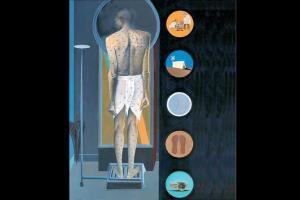
Surendran Nair, The Unbearable Lightness of Being, Corollary Mythologies, 1998. Oil on canvas. mage courtesy /Surendran Nair, Sakshi Gallery
Do I really look like that?" Noted artist Mukul Dey (1895-1989) remembered Mohandas Karamchand Gandhi asking him, when Dey showed him a pencil portrait that he had sketched. Dey had been granted an introduction to the Mahatma by Sarojini Naidu in Madras, now Chennai, in 1919, at the home where he was then staying. And while Gandhi had been informed of the errand that had brought Dey there—which was to "create with broad strokes the look of a new kind of leader"—he didn't pose like an artist's subject otherwise would. Instead, Dey recalled, "Gandhiji smiled sweetly at me, as if signifying his consent to my doing his portrait. He went on talking to the people in the room." The portrait, a side profile of Gandhi in close-cropped hair, a dark moustache and a prominent shikha, was completed in an hour. Although, it's hard to say from Dey's own retelling of this incident, whether Gandhi had been impressed with what he saw, the portrait came to represent the beginning of an insatiable fascination for the Mahatma among artists within the country and outside.
Academician and researcher Sumathi Ramaswamy's new book, Gandhi In The Gallery (Roli Books), explores why the Mahatma's hallowed presence on canvas and paper for over a century, and in different mediums, is not a mere coincidence. It has stemmed from a pre-occupation with Gandhi's acts of disobedience and defiance, be it the way he lived, dressed or the manner in which he pursued the fight for freedom. "Gandhi was a master choreographer of his own image," shares Ramaswamy, who is James B Duke professor of History and International Comparative Studies, and Chair of the Department of History, Duke University, Durham, North Carolina, USA.
Trending Stories
Latest Photos
Latest Videos
Latest Web Stories
ADVERTISEMENT
Mid-Day Fast
ADVERTISEMENT