Home / Sunday-mid-day / Article /
Tracing the journey of the block printers of Mohammed Ali Road
Updated On: 04 August, 2019 09:00 AM IST | | ekta mohta
As the only natural-dye printers in Mumbai, Ahmed and his son Sarfraz Khatri, have put their stamp on local and international runaways





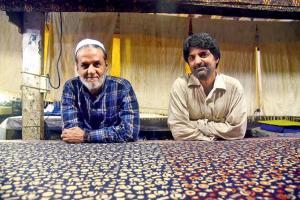
Ahmed and Sarfraz Khatri. Pics /Atul Kamble
The tight streets of Mohammed Ali Road have made room for all kinds of artists. Among them are the founders of Pracheen, a renowned block printing unit, in an otherwise run-down block. The 2,200 sqft space is workshop, store and durbar. This is where Ahmed Khatri, 63, a fourth-generation block printer, along with his son, Sarfraz, 39, meets us. This is also where he meets international designers such as Yohji Yamamoto and Donna Karan and local powerhouses such as Tarun Tahiliani and Priyadarshini Rao. "Tarun Tahiliani used to place a chatai there," says Ahmed. "At Pracheen, I tell him [Sarfraz], that we have to walk on the path of truth. If we had cheated in our journey, we wouldn't have reached this stage. You have seen how difficult it is to get to this lane. But thanks to god, our work has pulled people here."
The Khatris are the only block printers in Mumbai to use natural dyes. Brij Ballabh Udaiwal, an indigo expert from Sanganer, who has come to pay his respects, says, "So many people have diverted from this field to digital printing, screen printing and rotary printing. These two are mainly responsible for keeping natural dyes and block printing alive in Maharashtra." Their adjoining karkhana is chock-a-block with wooden blocks. Sarfraz estimates they have about one lakh blocks, a few of which are 90 years old. "I still have my ancestral blocks," says Ahmed. "I have revived them, repaired them or got them made new." The blocks are carved with different imprints: a few are flowers and leaves, turning the fabric into a forest floor; others are geometric and abstract, the canvas of a meditative painter. To create the patterns, "we refer to books from olden days to the new developments [in fashion magazines]," says Sarfraz. "One thing he has taught me is not just to pick up [a design] and place it. Innovate something and use it in a new way. And once it has been made, forget it and think of something better." Ahmed adds, "Make a story. The design should have a family."
Trending Stories
Latest Photos
Latest Videos
Latest Web Stories
ADVERTISEMENT

Ganeshotsav 2026

ADVERTISEMENT