Home / Sunday-mid-day / Article /
'He said Nana Fadnavis' face betrayed his feelings'
Updated On: 02 February, 2020 08:36 AM IST | Mumbai | Jane Borges
A surgeon-historian tracks the life of Scottish painter and compulsive documenter James Wales in Mumbai and Pune, calling his work the most comprehensive on 18th century Indian history





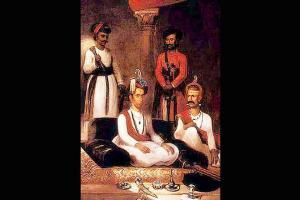
Sawai Madhavrao, Peshwa of the Maratha Empire, with Nana Fadnavis and attendants, in Poona, 1792. Pic/Wiki-Commons
Art is in the details. And if Pune-based historian Dr Uday S Kulkarni is to be believed, the only painter to have managed to capture the minutiae of everyday life, while memorialising the richness of the Marathas in the late 1700s was Scottish artist James Wales. Until then, there were the stray profile portraits of Chhatrapati Shivaji Maharaj and Peshwa Baji Rao that would eventually make their way to the museums of the world. But, it's Wales's "glorious technicolour" painting of Sawai Madhavrao (also known as Madhav Rao II), Peshwa of the Maratha Empire in India, "with its surrounding props and characters that made his subject life-like". "It almost looked better than a photograph," says 63-year-old Kulkarni.
It's this uniqueness of Wales's artistry, which first piqued Kulkarni's curiosity. His previous works, Solstice at Panipat and The Era of Baji Rao, engaged with 18th century Indian history. His new historical biography, James Wales: Artist and Antiquarian in the time of Peshwa Sawai Madhavrao (Mula Mutha Publishers), is no different.
Trending Stories
Latest Photos
Latest Videos
Latest Web Stories
ADVERTISEMENT

Ganeshotsav 2026

ADVERTISEMENT