Home / Sunday-mid-day / Article /
How children play a major role in COVID-19 transmission
Updated On: 11 October, 2020 07:56 AM IST | Mumbai | Prutha Bhosle
While we may have lost precious time for research by assuming that children arent at as much risk of contracting COVID-19, recent findings say they could become spreaders, and schools, hotspots





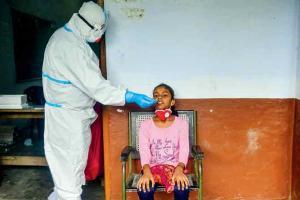
Researchers say that one of the biggest challenges is that children are less likely than adults to have symptoms, meaning many infections may go undetected. PIC/AFP
While children are usually seen as vulnerable, a few weeks into the Coronavirus pandemic, several global researchers observed that children's risk of needing hospital treatment for COVID-19 infection was "tiny". Among these, a study in the BMJ—a weekly peer-reviewed medical journal in Britain—gained most attention. It looked at 651 children with Coronavirus in hospitals in England, Wales and Scotland. A "strikingly low" one per cent of them—six in total—had died in hospital with COVID-19. Compare this with 27 per cent across all other age groups. Eighteen per cent of the children needed intensive care. And the six who had died had "profound" underlying health conditions that had often been complex and themselves life-limiting. Some more papers came to the fore, claiming kids were less likely to catch and transmit the virus.
In the first week of September, however, the World Health Organization (WHO) made an announcement that seemed at odds with what was being assumed thus far. It recommended that children aged 12 and beyond should wear masks, and that masks should also be considered for those aged between six and 11. "The assumption that kids will not transmit the virus came from Sweden. Throughout their lockdown, they kept the schools open, while anything else that involved congregation of individuals was not allowed. This led to a feeling that kids don't transmit the virus," believes Dr Lancelot Pinto, consultant respirologist, PD Hinduja Hospital, Mumbai.
Trending Stories
Latest Photos
Latest Videos
Latest Web Stories
ADVERTISEMENT

Ganeshotsav 2026

ADVERTISEMENT