Home / Sunday-mid-day / Article /
In Memoriam
Updated On: 09 January, 2022 07:42 AM IST | Mumbai | Sucheta Chakraborty
A filmmaker recollects experiences of working with acclaimed Bengali actor Soumitra Chatterjee in a book that aims to introduce him to a wider audience familiar only with his work with Satyajit Ray





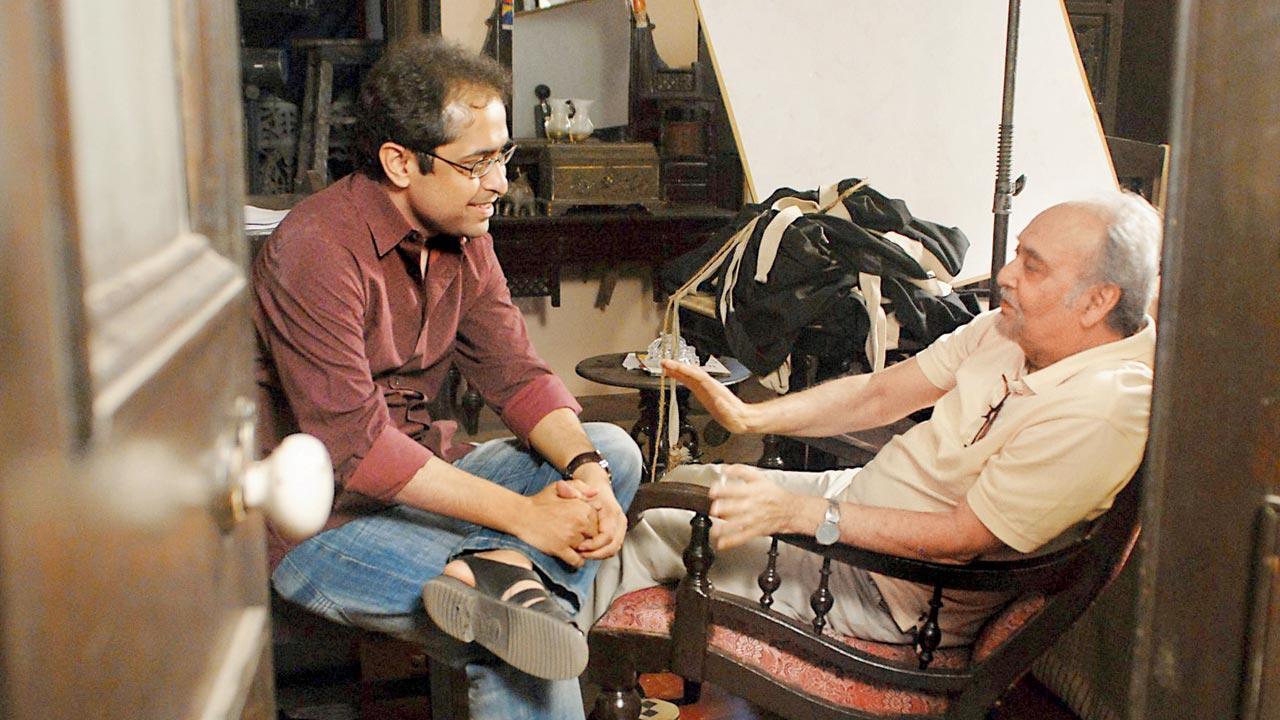
In his new book, Ghosh traces his observations and interactions with Soumitra Chatterjee and the forging of a personal and artistic relationship through five films over 15 years
In November 2020, in the days following actor, poet, playwright, painter and singer Soumitra Chatterjee’s passing, filmmaker and professor of Economics Suman Ghosh remembers being mired in sadness. Around this time, Shantanu Ray Chaudhuri, editor-in-chief at Om Books International, who had previously written on the themes of memory, ageing and death in Ghosh’s films with Soumitra Chatterjee, proposed the idea of a book on the director’s personal and artistic relationship with Chatterjee. While initially hesitant, given that the book would be a daunting one, not least because it would be his first, Ghosh realised that this would offer the cathartic release he needed at the time. “Rather than lament his passing, I thought why not share my experiences with people and help them get an intimate glimpse of the man,” says the director. Soumitra Chatterjee: A Film-Maker Remembers, which released last week to commemorate the actor’s birthday this month, traces Ghosh’s observations and interactions through five films over 15 years with “the last of Bengal’s Renaissance men”.
Ghosh writes about being in awe of Chatterjee’s stature as he watched the actor during shoots at a time when he was still a PhD student at Cornell, eager to venture into filmmaking. “I never expected to form a personal relationship with him. He had achieved so much in life, why would he be interested in giving a hundred per cent in a film with a debutant filmmaker like me?” wondered Ghosh who cast Chatterjee in Podokkhep (Footsteps; 2006) about a retired man and his bond with a little girl in a film inspired by F Scott Fitzgerald’s story The Curious Case of Benjamin Button about a man aging in reverse. While the sharpness of his craft was expected, what surprised Ghosh about the thespian was his hunger to work with younger directors and with newer mediums and formats right till the end. There was also, he recalls, a child-like curiosity in him for the mysteries of life, a quality he says he has observed in other greats like Amartya Sen, the subject of an early documentary. He remembers how the last conversation he had with the actor was a few months before his passing when the actor, a well-known workaholic, was forced to sit at home during the pandemic. “He was reading a book on the young Galileo, and discovering how his father who was a musician impacted him,” he shares. “I marvelled at this man who in spite of a pandemic ravaging the world and making people mentally and physically sick could still hold on to his sense of wonder.” Everything from cricket and Garry Sobers to Satyajit Ray, the Masai tribes of Africa and the new Bengali literature and cinema interested him, he says, their conversations on these myriad subjects a generous source of nourishment for the director. “… It was as if he wanted to perpetually soak in the delirium of life and be bathed in all its beauty. His mind was like a blank canvas, ready to be painted with colours,” writes Ghosh in the book, pointing to how this receptiveness also informed his work as an actor.
In one of the book’s many interludes, Ghosh writes fondly about Chatterjee’s visit to his home and his mother’s trepidation over the lunch being served even as she grappled with the fact that the man she had watched growing up in such classics as Charulata and Apur Sansar would be in her home. Among other memories of the artiste Ghosh holds dear are those of his Rabindra Sangeet sessions with cinematographer Barun Mukherjee in between shots.
Trending Stories
Latest Photos
Latest Videos
Latest Web Stories
ADVERTISEMENT

Ganeshotsav 2026

ADVERTISEMENT