Home / Sunday-mid-day / Article /
Increasing the net income
Updated On: 06 September, 2020 08:23 AM IST | Mumbai | Anju Maskeri
Good things come out of a pandemic too. A fishing cooperative society has joined hands with a data analytics firm to use an app and QR codes in pushing for sustainable catching and consumption practices





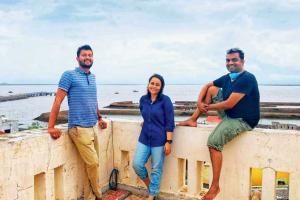
Ganesh Nakhawa, director of Karanja Fishing Co-operative Society, Devleena Bhattacharjee, founder of Numer8 Analytics Pvt Ltd, and Myron Mendes from the Indian Network on Ethics and Climate Change
THE lockdown announced by Prime Minister Narendra Modi on March 24, to control the spread of the Coronavirus, left many businesses in the lurch due to the disruption of demand and supply chains. Ganesh Nakhawa, director of Karanja Fishing Co-operative Society, says that large quantities of fish had to be thrown away. According to estimates, around 10,000 metric tonnes of fresh catch was dumped back into the sea during the first week of the lockdown. "There was no access to refrigeration facilities, transportation or acquisition of ice, which left fishermen with no choice. Even exporters, who form a chunk of buyers, did not make any purchase. It seemed we had hit a dead end."
Determined to tide over the crisis, Nakhawa started to sell the catch directly to consumers with the help of friend Myron Mendes, who works with the Indian Network on Ethics and Climate Change. From selling to a handful of residents in Andheri East, they are now supplying two tonne of fish daily across the city, managing to re-engage 600 fishermen in the business. But their mission doesn't end here. Nakhawa and Mendes have teamed up with Devleena Bhattacharjee, founder of Numer8 Analytics Pvt Ltd, a data science firm, to bring sustainability and traceability to the fishing trade. Through their app, O Fish, they are also helping the community identify fishing zones, acquire a good catch, eliminate middlemen, learn of weather safety guidelines and embrace long-term sustainable practices. Fish is now sold to customers with a QR code on the packaging, containing details of when, where and by whom it was caught. "The fishing community had suffered due to climate change stressors. Rising ocean temperature, increased acidity and changes in salinity has lead to fish population shifts. We realised this when we began analysing fishing zones and community fishing practices in 2018," says Bhattacharjee.
Trending Stories
Latest Photos
Latest Videos
Latest Web Stories
ADVERTISEMENT

Ganeshotsav 2026

ADVERTISEMENT