Home / Sunday-mid-day / Article /
Let's get physical
Updated On: 13 September, 2020 08:08 AM IST | Mumbai | Gitanjali Chandrasekharan
Anthropologist to global firms, Simon Roberts presents an argument that takes the shine off the mind, and focuses on the bodys innate ability to remember





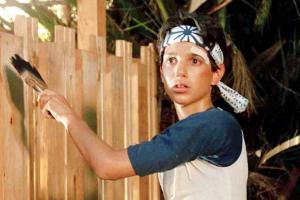
A still from The Karate Kid, which released in 1984
There's a scene in the new cult series Cobra Kai, when a lanky Demetri, played by Gianni Decenzo, considers Sensei Danny's fence painting instructions—one that Danny inherited from his own sensei Mr Miyagi back in 1984—and realises that it is just a method of building muscle memory. If one were to look for a pop culture ode to muscle memory, the four movies in The Karate Kid series and the new Netflix series would perhaps be it.
Yet, there are more complexities to muscle memory than just learning a few steps to a process and then being able to perform them absent-mindedly—like entering the PIN to your debit card at an ATM. It's this that anthropologist Simon Roberts, who advises global organisations like Intel, Facebook, Spotify and Google, through his London-based consultancy Stripe Partner, has explored in his new book aptly titled, The Power of Not Thinking (published by Bonnier, represented in India by HarperCollins). Roberts starts by discussing the act of driving and why this has been difficult to Artificial Intelligence. Simple instructions such as accelerate, or "watch out for someone on the road" he points out, are difficult to translate into binaries. A driver who is decently good, will be able to know exactly how much pressure to apply on the accelerator without thinking about it. They will be able to judge the actions of the person on the road—"Is he getting into the passenger seat of the parked car ahead, or is he going to cross the road?"—without much consideration. He writes: "Humans interpret these situations without applying much conscious thought to it, but building a machine that can make sense of scenarios like these is very hard." And so, the need to understand that we as humans possess knowledge not just in our brains, but also our body, which he calls embodied knowledge.
Trending Stories
Latest Photos
Latest Videos
Latest Web Stories
ADVERTISEMENT
Mid-Day Fast
ADVERTISEMENT