Home / Sunday-mid-day / Article /
The art no one wants to call their own
Updated On: 19 January, 2020 08:15 AM IST | Mumbai | Anju Maskeri
William Darlymple's latest book celebrates faceless Indian artists commissioned by the East India Company who developed a unique style that was two-third Mughal, one-third European, but ignored by both India and England





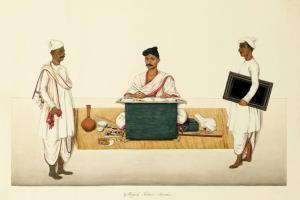
Yellapah Picture Moochee, self-portrait of Yellapa. Pics courtesy/ Forgotten Masters
A painting in the Vellore Album, housed at Sotheby's New York, shows Indian artist Yellapah of Vellore seated cross-legged in front of a drawing table with the paraphernalia of his trade strewn around him. Flanked by two assistants, Yellapa's gaze is firmly on the viewer. The inscription below reads, Yellapah Picture Moochee. The arresting self-portrait dates back to 1825. But, until recently, Yellapah was unknown in India.
Scores of Indian artists like him, who created extraordinary paintings under the patronage of the East India Company, and its officials, have gone largely unnoticed. William Darlymple's latest book, Forgotten Masters: Indian Painting For The East India Company, seeks to correct the wrongs by drawing focus on this neglected phase of Indian art history. "It all began in 2013 when I was curating a show on Mughal art in New York, which had a few frames from the current collection," says the Delhi-based author and historian. He found it problematic that most of these paintings, indistinguishable from Mughal paintings, were unceremoniously categorised as "Company school paintings".
Trending Stories
Latest Photos
Latest Videos
Latest Web Stories
ADVERTISEMENT

Ganeshotsav 2026

ADVERTISEMENT