Home / Sunday-mid-day / Article /
The colour of money
Updated On: 24 October, 2021 08:31 AM IST | Mumbai | Sucheta Chakraborty
As part of a German arts company’s project on white funds for art commissioned from the Global South, an Indian theatre artiste will present a humanistic idea of money





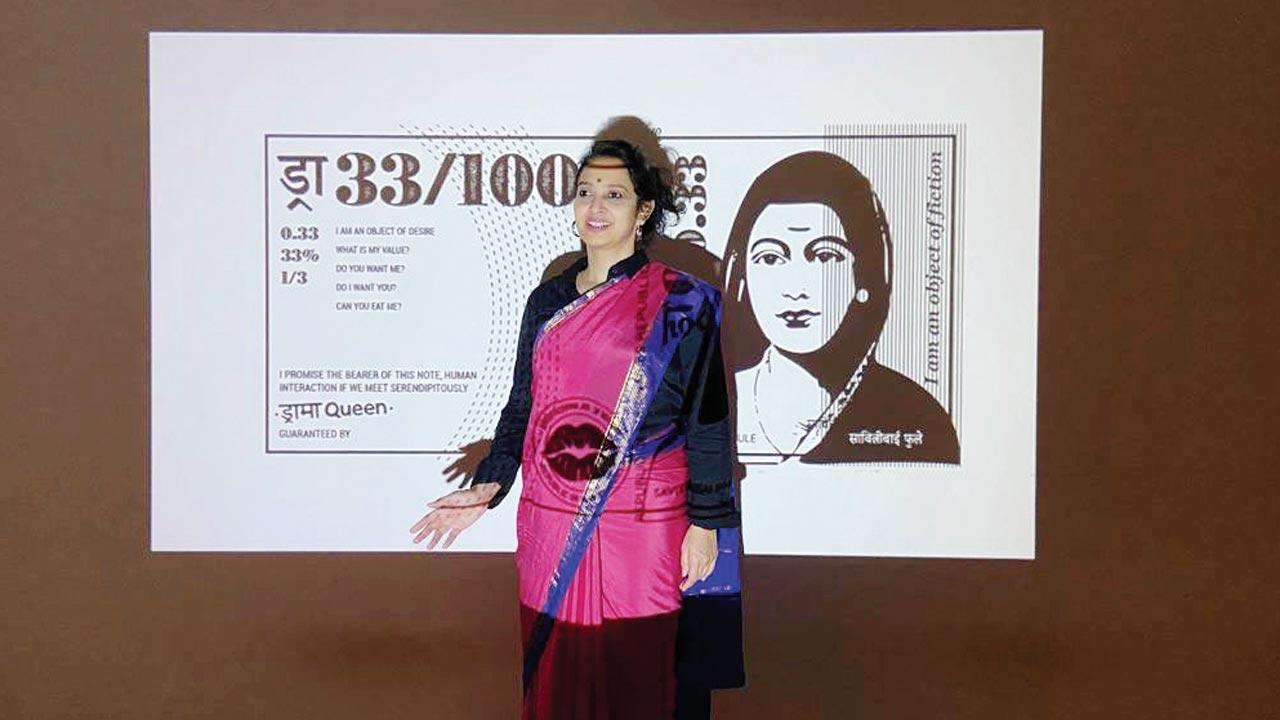
Ghosalkar says that the notes are quite dense, themselves becoming objects of art. Pic courtesy/Debanshu Bhaumik
Anuja Ghosalkar, who divides her time between Bengaluru and Mumbai, has since 2015 practised a form of documentary theatre that focuses on personal and oral histories, archives and materials, exploring subjects like technology, gender and intimacy while breaking the hegemony of the playwright, the director and the actor in conventional theatrical practice. Her Bengaluru-based theatre company Drama Queen through well-travelled shows like Lady Anandi—about her great-grandfather, a female impersonator in late 19th century Marathi theatre and narrated using archival photos as projections on her body—and workshops have sought to build audiences and the language of documentary theatre in India, a form borrowed from the German theatrical tradition. Ghosalkar is also the curator of the popular Lonely Hearts Club on Instagram which invited recordings of erotica from listeners, her attempt being to subvert the algorithm of Instagram, encouraging people to listen instead of being driven purely by the visual. Earlier this month, supported by the Goethe-Institut Mumbai, contributors to the club performed virtually on Zoom exploring issues around online erotica and voyeurism among other things.
Next month, Ghosalkar will be participating along with five other international artistes in Berlin-based performing arts company Flinn Works’ White Money project, devoted to the theme of money that flows from Europe to fund artists in the Global South, requiring them to cater to orientalist or exotic images of non-white cultures and thereby reinforcing racist and neo-colonial structures. “It is an idea whose time has come because museums across the world are trying to decolonise their wares,” she tells us over a telephonic call. “The moment is right to think about money and its politics.”
Trending Stories
Latest Photos
Latest Videos
Latest Web Stories
ADVERTISEMENT

Ganeshotsav 2026

ADVERTISEMENT