Home / Sunday-mid-day / Article /
The future of the arts
Updated On: 11 August, 2019 07:11 AM IST | | ekta mohta
Former Culture Secretary of India Jawhar Sircar will speak at the inaugural Jamshed Bhabha Memorial Lecture at the NCPA this month. And, he won't mince words on what ails the arts in India today





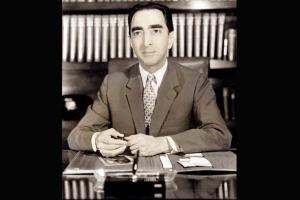
Dr Jamshed Bhabha, founder, NCPA
Jawhar Sircar, an IAS officer for 42 years, with long stints as India's Culture Secretary and CEO of Prasar Bharati, doesn't talk in government gobbledygook. The first speaker of the Jamshed Bhabha Memorial Lecture at the NCPA, he's going to hold forth on what ails the arts in India. And, he has a list. "I'd be trying to cover, in the space of about 50 minutes, a whole sweep of the arts," he says, from a landline in Kolkata. "For instance, antiquities. India is an ancient civilization that has literally millions of antiquities that need to circulate, but just a small section is visible in museums. There are many wonders that have gone underground, because of this stupid Act in 1972 called The Antiquities Act, which makes criminals out of all of us." The Act was intended to stop smuggling and to keep our antiquities within our borders. To which he says, "Fair enough. But, as you know, the maximum smuggling happened in the '70s and '80s, when every Hindi film had this gora smuggler, who would come to India, give an attaché full of cash and say, 'Meri murti kahaan?' All of Bombay film knew, but the stupid government didn't that this Act had actually done the reverse."
Building on this thread, he's going to touch about "how the central museums have screwed their own lives" and how we got our antiquities in the first place. "How we reconstructed and retrofitted Indian history. We have to understand the national narrative: surgery was done on Lord Ganesh, and pushpaks used to fly with Indigo-type tickets. This bizarre pride in everything that India was superior, when exactly 150 years ago, not a single Indian knew what his past was. The entire Vedic period has not left behind a spoon. Ashoka Maurya was not known to Indians still 1870. It was only in 1857 when [James] Prinsep discovered him, and for the next 20 years, there was a fight whether this fellow actually existed. Now we have appropriated him as the most glorious character after Akbar. What I'm trying to say is that this linear history, which India forgot in its amnesia, the archaeologists discovered through a spade."
Trending Stories
Latest Photos
Latest Videos
Latest Web Stories
ADVERTISEMENT

Ganeshotsav 2026

ADVERTISEMENT