Home / Sunday-mid-day / Article /
The party pooper
Updated On: 11 July, 2021 09:02 AM IST | Mumbai | Anju Maskeri
As the government seeks solutions for the bird dropping problem in its top green-rated building in the capital, avian experts and conservationists suggest ideas to tackle the menace on a national scale





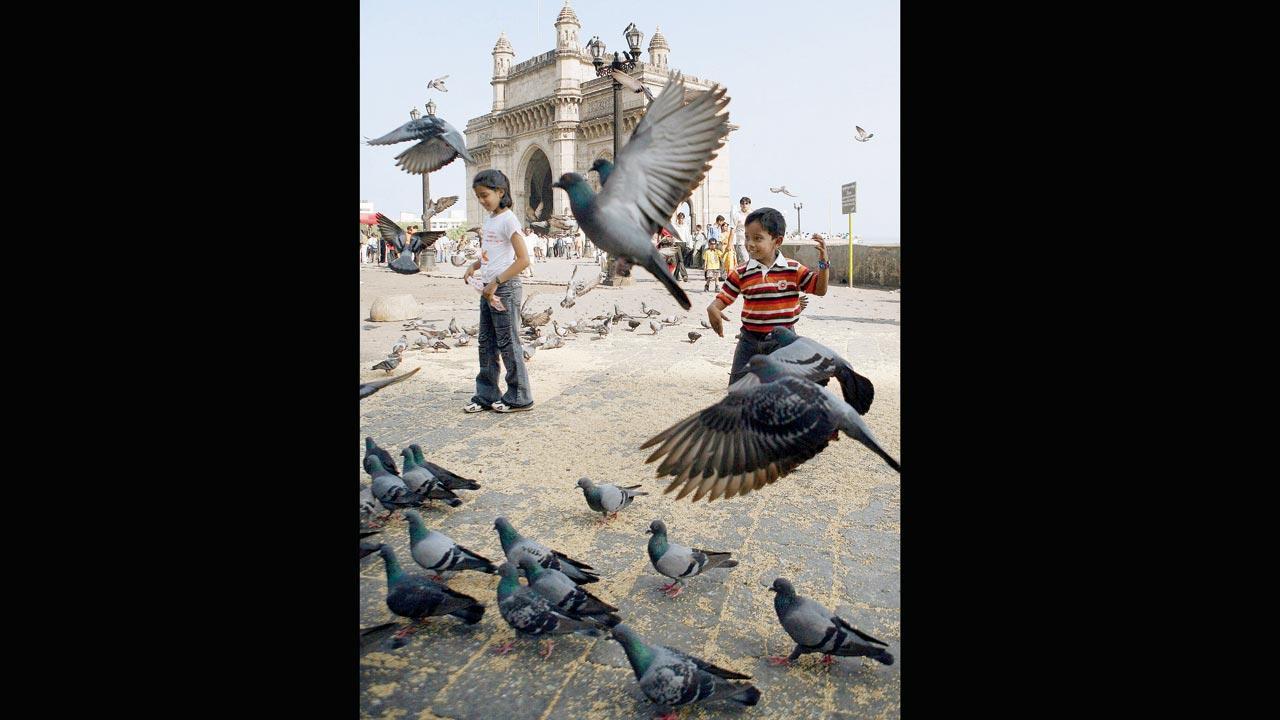
Children feed pigeons in front of the Gateway of India, a Grade-1 heritage structure. Built in Indo-Saracenic style, the foundation stone for the structure was laid on March 31, 1911. Pic/Getty Images
The authorities at Indira Paryavaran Bhawan in Delhi, India’s highest green-rated building, seem to be dealing with a whole lot of crap. The courtyard, dotted by plantations and grass, attracts birds. And, with them comes faeces. The bird poop problem has intensified over the years, and last week, the Union environment ministry invited proposals from the public to solve the challenge. “Organisations/Institutes/companies/individuals having technical know-how and past experience may offer a solution, which is environment friendly, technically sound, implementable, operationally feasible, cost effective and ensures labour safety,” the advertisement published on the website read. The one to come up with the best solution will be awarded Rs 1 lakh.
Long before the government declared the threat of birds to heritage structures a problem, a team of Indian Institute of Technology and Indian Institute of Management graduates had begun researching the subject. It took them two years and a slew of trials to come up with their just-launched pigeon repellent spray. “We looked at pigeons, among the bird species specifically because the problem is not about cleanliness alone. Their droppings are a hazard to human health since they contain nitrogenous waste instead of ammonia. That said, we were clear about one thing: our formulations should not harm the birds in any way,” says Puneet Gupta, founder and CEO of Clensta. The Delhi-based startup aims to develop environmentally compassionate products. The issue of transmissible bird diseases associated with pigeons, he says, blew up in 2019 when three lots of MDH sambar masala were recalled from retail stores in California after tests by the United States Food and Drug Administration (FDA) showed them positive for salmonella. “Their team came to India to investigate the matter but could not locate the cause in the factory. Later, they discovered sites near the factory where pigeons would roost. Once the droppings dry up, bacteria settles on them, eventually contaminating the manufacture of masalas nearby.
Trending Stories
Latest Photos
Latest Videos
Latest Web Stories
ADVERTISEMENT

Ganeshotsav 2026

ADVERTISEMENT