A family in a temple
Updated On: 02 February, 2020 08:08 AM IST | Mumbai | Devdutt Pattanaik
But for Hindus, these are various manifestations or expressions of the same divine principle, different facets of divinity expressed through a family unit. We see this at Shiva, Vishnu and Devi temples





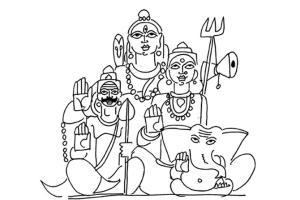
Illustration/Devdutt Pattanaik
%20(1).jpg "Devdutt Pattanaik") In a typical Hindu temple, we do not find just one image. We find multiple images. For many people, unfamiliar with Hindu tradition, this looks like polytheism. But for Hindus, these are various manifestations or expressions of the same divine principle, different facets of divinity expressed through a family unit. We see this at Shiva, Vishnu and Devi temples.
In a typical Hindu temple, we do not find just one image. We find multiple images. For many people, unfamiliar with Hindu tradition, this looks like polytheism. But for Hindus, these are various manifestations or expressions of the same divine principle, different facets of divinity expressed through a family unit. We see this at Shiva, Vishnu and Devi temples.
Shaivism deals with the hermit, Shiva, who becomes a householder. We always see the image of the hermit with his wife and two sons: Karthikeya, who makes us feel secure, and Ganesha, who nourishes us. So, our mundane needs—hunger and fear—are taken care of by the two sons of Shiva. The parents, Shiva and Shakti, represent more transcendental ideas of mind and body, or spirit and substance, purusha and prakriti. That is the Shiv Parivar. Before them is the Nandi bull and sometimes, Brahma, or Vishnu, in the form of a turtle.
Trending Stories
Latest Photos
Latest Videos
Latest Web Stories
ADVERTISEMENT

Ganeshotsav 2026

ADVERTISEMENT