B for Bapu, B for Bombay
Updated On: 31 January, 2021 08:08 AM IST | Mumbai | Meher Marfatia
How do the young view Gandhi's life and times and teachings? Visual historian Dr Sumathi Ramaswamy shares her discoveries of the Mahatma interpreted by Bombay schoolchildren's art





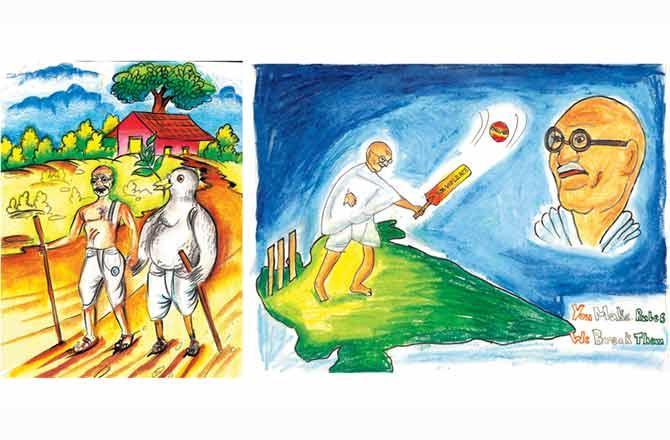
(From left) Shubham, Gandhi in My Dreams, Standard IX, GPP High School, Vile Parle, 2012. Pavitra, Untitled, Standard III, JB Vachha High School, Dadar, 2015; Pics courtesy Mani Bhavan Gandhi Sangrahalaya and Gandhi Smarak Nidhi, Mumbai
 In 1920, Gandhiji launched the epoch-turning Non-Cooperation movement in the city. To mark its centenary year, the Bombay Local History Society recently held an online public lecture by visual historian Dr Sumathi Ramaswamy, whose riveting research explores the work of city artists on the theme. Titling her talk, A Brush with Bombay's Bapu, the Professor of History and International Comparative Studies at Duke University, North Carolina, says, "Mumbai had a special place in the Mahatma's life. Not surprisingly, several scholars have explored his relationship with the city, but none considered the special attention Bombay artists, from the unknown to the famous, lavished upon the Mahatma. I took on this topic to discover what we learn about Bombay and Bapu if we move the image to the centre of our analysis."
Dr Ramaswamy has published extensively on language politics, gender studies, spatial studies and the history of cartography, visual studies and the modern history of art, as well as digital humanities and the history of philanthropy. Her published works include Gandhi in the Gallery: The Art of Disobedience, The Goddess and the Nation: Mapping Mother India and Husain's Raj: Visions of Empire and Nation. She has edited Barefoot across the Nation: Maqbool Fida Husain and the Idea of India, and co-edited Empires of Vision. Among her digital curatorial projects are Going Global in Mughal India and B is for Bapu: Gandhi in the Art of the Child in Modern India.
Trending Stories
Latest Photos
Latest Videos
Latest Web Stories
ADVERTISEMENT

Ganeshotsav 2026

ADVERTISEMENT